Showing posts with label Review. Show all posts

Sunday, August 28, 2011

The Secret History


Title: The Secret History
Author: Donna Tartt
Gist: “The Secret History” is the story of six friends  (Richard, Camilla, Charles, Edmund, Francis and Henry) who attend a very posh university in rural New England. They have it all: beauty, wealth, sophistication, intelligence, exclusivity, mystery, and are connected by an unparalleled devotion to studying Ancient Greek.
Driven by the boredom of not having a care in the world, they begin to engage in a wide array of immoral activities that test their apparent limitlessness. Their demented devotion to extreme experiences eventually tear them apart and leads to their individual demises. 
Told though the first person narration of this groups latest inductee, Richard (who unlike the other five comes from a middle-class family and is most sensitive to the strange behaviors of the group), this is a tragic but extremely sophisticated coming-of-age mystery that starts with the death of one of group member and and ends with the death of another. The suspense surrounding the reason behind each death is worth the 576 page effort because it unveils the ugliness behind the impeccably beautiful introductory facade Camilla, Charles, Edmund, Francis and Henry put up when they first meet Richard. The five of them easily comprise the most attractive and captivating set of supporting characters I’ve encountered in all fiction I’ve read this year. Like some mysterious, beautiful yet dangerous creatures, they live their outlandish lives beautifully and meet their tragic ends just as beautifully.
Richard is the narrator, but in many ways he is no more involved in the story than the reader. Like us he is taken for a strange ride as a spectator, incapable of changing the course of events set in motion by the other five. It’s only his sense of undying devotion and curiosity about what is to unfold that keeps him and us astride for the whole ride. We are Richard and Richard is us from start to finish. 
Quote:
"It's a very Greek idea, and a very profound one. Beauty is terror. Whatever we call beautiful, we quiver before it. And what could be more terrifying and beautiful, to souls like the Greeks or our own, than to lose control completely?...To be absolutely free!...To sing, to scream, to dance barefoot in the woods in the dead of night, with no more awareness of mortality than an animal! These are powerful mysteries...If we are strong enough in our souls we can rip away the veil and look that naked, terrible beauty right in the face; let God consume us, devour us, unstring our bones. Then spit us out reborn." 
Pros: 
  • Great supporting characters-Camilla, Charles, Edmund, Francis and Henry are like an unhealthy addiction. You hate them, but can’t tear your gaze away either. 
  • The gothically romantic and sometimes chilling mood Tartt is able to infuse into her writing (if you’re into that stuff, of course).
Cons: 
  • There is a feeling of pretentiousness about this book and its supposed complexity, which can be off-putting from time to time.
Target Audience: lit majors
More Like It: Brideshead Revisited 
Extra: Check out Fravorwire’s casting of “The Secret History” the the movie. 


Rating: A-

Thursday, March 17, 2011

Review - Trapped by Michael Northrop

Summary (from Goodreads): The day the blizzard started, no one knew that it was going to keep snowing for a week. That for those in its path, it would become not just a matter of keeping warm, but of staying alive....

Scotty and his friends Pete and Jason are among the last seven kids at their high school waiting to get picked up that day, and they soon realize that no one is coming for them. Still, it doesn't seem so bad to spend the night at school, especially when distractingly hot Krista and Julie are sleeping just down the hall. But then the power goes out, then the heat. The pipes freeze, and the roof shudders. As the days add up, the snow piles higher, and the empty halls grow colder and darker, the mounting pressure forces a devastating decision....


I chose to read this book because, well, I love survival stories. I have to admit, I’ve thought more than once about how long the contents of my pantry would last in a disaster. Also, my area had just got hit with a snow storm (hopefully the last of the season) that took us from muddy grass to a thick blanket of white overnight. It was kind of an awesome time to be curling up in the chilly basement, reading about surviving a giant nor’easter. It got to the point where I had to put the book down and turn on the TV just to convince myself that we hadn’t lost power like the characters in the book (even though at that point, I was reading under electric lights and drinking hot coffee and it had stopped snowing hours ago… clearly my situation was not dire).

A chilling story (sorry for the pun, not intended). Not so much action-packed but there is an underlying sense of urgency throughout the book. How long will the storm last? What will they do about heat, food, rescue… And does anyone even know they’re at the school?!?

I would have rated this book better if there had just been one more chapter. The ending was unnecessarily jarring and abrupt. It wasn't about finding out "what happened next". I can guess enough to be satisfied (mostly). It was that things happened quickly toward the end. There were even super-short chapters to quicken the pace, and then it was done. End of story. The book desperately needed one more chapter to unwind the tension the climax of the story had built up. As it was, I felt cheated out of an ending.

The whole story was told in a "let me tell you about" tone, very conversational. From the beginning we, the readers, got spoilers of things to come, from comments liked “we didn’t know it at the time but…”. It added an extra bit of creepy, especially when the narrator says things like “our numbers would only get smaller from here”. This also made the abrupt ending even more annoying… our narrator didn’t do anything to catch us up to his “now” even though we know he’s telling us this story after at least a little time had passed.

I enjoyed the group dynamic, how the characters change how they interact when suddenly their world is down to just seven kids: Les, the trouble-maker; Elijah, the weird goth kid; two girls: beautiful Krista and her friend Julie; our narrator, Scotty; and his two friends, Pete and Jason. Kids who normally wouldn’t have known much about each other are suddenly relying on each other for survival. Social hierarchy isn’t completely gone, though, just different. The little groups of friends still stick together mostly, and the presence of girls in the room get the guys tangled up in knots. But Jason’s knowledge of construction and home repairs is suddenly an asset. They learn Les’ has more of a problem with rules and adults than other kids. And the goth kid’s not really goth at all, just different, even funny.

Bottom line: It's an entertaining survival story with an annoyingly abrupt ending.

Lit Snit Verdict: C (but would have been a B+ if only there had been an ending)

Tuesday, March 15, 2011

Review - Waiting For Columbus by Thomas Trofimuk

Summary (from Goodreads): On a beautiful April morning, a man is brought to an insane asylum in contemporary Spain, claiming to be the legendary navigator Christopher Columbus. Found in the treacherous Straight of Gibraltar, he is clearly delusional and has suffered a trauma so severe that he has turned away from reality. As he spins the tall tales of adventure and romance of someone who existed in the late fifteenth century, the lonely Nurse Consuela can’t help but be enchanted by his spirit. Who is Columbus? Where did he come from? This dazzling story about one man’s painstaking search for truth and loyalty will haunt the reader long after the final page.

Modern-day Spain is beautifully blended with the 1400s Spain, as the man who calls himself Christopher Columbus tells nurse Consuela his stories. A chapter might start with a scene in the institution (playing chess or talking to another inmate who believes herself to be the pope), and in the next scene, we’re in Spain in era of the Inquisition and the push for finding a new route to Marco Polo’s Indies, hearing about the lovers Columbus had, the attempts to convince Spain’s royalty to back his explorations.

Nurse Consuela is intrigued by Columbus… Who wouldn’t be? A masterful storyteller reminiscing on the days (in recent past, according to him) of struggling against the perception that the world is flat (though Columbus is quick to call anyone who still thinks that an idiot). Still, it is a challenging feat to get the queen and king of Spain to buy into Columbus’s obsession with learning what would happen if you sail West. The question is not whether or not the world is flat, but how big the world is. Could a ship can survive long enough to make it to the other side?

My one gripe with the story (and it’s a small one) is that the book switches point of views a lot. The three main perspectives were Consuela, Columbus and Emile (an Interpol investigator looking for a missing person). Even in Columbus’s stories to Consuela, though, we might find ourselves switching--mid-scene--to seeing the story from inside the head of Queen Isabella, perhaps, or his friend Benito. While each of these perspectives were interesting, I found myself needing to pay more careful attention than I was used to, rereading passages when I missed a POV switch.

There is a love for the written word in this tale. The characters have discussions of philosophy, religion and poetry. This is not a plot-heavy story. Most of it is told through the flashbacks (as Columbus is telling Consuela). Peeking through the story of Christopher Columbus is perhaps a real man hidden behind the historical figure. He wears a wedding band. His stories contain elements that don’t belong in the 1400s. He wants to call the queen on the telephone. How much of his stories are real? Why does this man think he is Christopher Columbus?

This was memorable story with a satisfying conclusion.

Lit Snit Verdict: A-

Thursday, March 3, 2011

Review - The Birth of the Dread Remora

Summary (via Amazon.com): Nathaniel Demming is a midshipman aboard the HMES Remora, the very first ship to go beyond their world's waters and out into the ether. He and the rest of the crew are ready for adventure, eager to explore the unknown and chart a new course for the rest of their world to follow. But what they find out there will change their lives, and their perspective, forever. The ether is not empty at all, but teeming with life--including vicious marauders waiting to prey upon the hapless Remora. Can Demming help his friends and fellow officers through the crises that await? Can they survive the dangers all around them? And can he convince them to transform their ship and themselves into the antithesis of everything they trained for, while still holding true to everything they believe in?

Birth of the Dread Remora is the first tale of the epic Scattered Earth saga, and the first in a series of swashbuckling adventures about the space-pirate ship the Dread Remora!


This book has a really unique premise. In a future era of the human race, people live underwater. Knowledge of the universe has been lost since our time, but the people here know that above the water is air, and above the air is ether, but what's in the ether? When a strange, new light appears to be coming from beyond the air, a mission is formed to learn more. The story begins on the maiden voyage of Remora, the first ship to travel into the ether.

The ether is nothing like they expected. The main conflict in this book centers not on the mysterious light (which is forgotten fairly quickly) but rather around tension between the ranks and encounters with aliens who lurk in the ether and attack the Remora. The officers must find a way to protect themselves from dangers they weren’t prepared for.

This is book one of the Scattered Earth series, which I was interested to learn is / will be written by three separate authors. While this book followed Demming and his crew, the Scattered Earth series promises three worlds, three storylines, all ultimately connected.

There were several times throughout the book where I had a "wait, what??" moment, reading something that I wished had been explained better. Like, the underwater galley being stocked with soup and crackers, a girl sheened in sweat after a workout (still underwater), aliens who speak English. And at one point they mentioned seeing a burning globe like the sun, but much larger--what was that supposed to be? Unless I got their travel-time/speed wrong, the whole story took place within the solar system. Maybe there are good explanations for these things, but the idea of an aquatic race eating soup & crackers still puzzles me.

I liked the characters in this book. Our main character, Demming, is so eager to be a part of this mission. In his hopes to make the cut, Demming takes stock of each of the character's strengths and weaknesses as a leader, and it is from this perspective that we meet the rest of the crew.

Despite the "what, what?" moments, I did enjoy this story. It was an interesting premise (really, how often do you get to take a ship filled to the brim with water and explore outer-space & meet aquatic characters who are neither mermaids nor clown fish?), and I'm curious to see where the next installments of the series takes the story.

* This book was supplied by the publisher for review.

Lit Snit Rating: C+

Monday, February 28, 2011

Review — Demonglass by Rachel Hawkins

Summary (via Goodreads): Sophie Mercer thought she was a witch.

That was the whole reason she was sent to Hex Hall, a reform school for delinquent Prodigium (aka witches, shapeshifters, and fairies). But that was before she discovered the family secret, and that her hot crush, Archer Cross, is an agent for The Eye, a group bent on wiping Prodigium off the face of the earth.

Turns out, Sophie’s a demon, one of only two in the world—the other being her father. What’s worse, she has powers that threaten the lives of everyone she loves. Which is precisely why Sophie decides she must go to London for the Removal, a dangerous procedure that will destroy her powers.

But once Sophie arrives she makes a shocking discovery. Her new friends? They’re demons too. Meaning someone is raising them in secret with creepy plans to use their powers, and probably not for good. Meanwhile, The Eye is set on hunting Sophie down, and they’re using Archer to do it. But it’s not like she has feelings for him anymore. Does she?


Review:  Oh, Sophie.  I'd forgotten how much I loved your snarky, sarcastic way.  I will admit when I heard that Sophie and company were spending a summer in London I thought, "ugh, an entire book of 'What I Did On My Summer Vacation?  Lame.  Hex Hall, I thought you were better than this."  Oh, how wrong I was.  Rachel Hawkins took something that could have easily been a fun series about supernatural creatures in reform school and completely pulled the rug out from under us, making the reader question everything they've come to learn about the Hex Hall world.

Before I get to all the craziness that had me practically yelling at my book to stop it and just go back to Hecate Hall where everything would go back to normal, let's address the love triangle.  I've gotten pretty sick of love triangles, but I have to say I'm just as torn as Sophie.  Throughout the first half of the book I'm completely "TEAM CAL!  Woohoo!" but then Archer shows up and is all sarcastic and there's a lot of sexy banter and I become more "Team Cal?  Right?  We're Team Cal here...I think..." (I, actually, am totally Team Cal, but I think it's more of Team Cal For Erin because he's impossibly cute and stoic and I may want to have his babies)  However, there is some crazy/good chemistry between Archer and Sophie that's just impossible to deny.  Though, I will say, I wanted to shake Sophie a few times.  Note for the future, Soph, do not tell your ex-crush/kissing buddy exactly where you are hiding out from his brethren that want you dead! 

Also, I know you're in love with him but don't just go on some portal-hopping adventure without a second thought.  I didn't totally understand Archer's motives with Sophie in terms of helping her investigate whoever's creating demons, but I found myself brushing past it as they distracted me with their snarky, sexy banter.

Besides my love for sweet, dependable Cal, I know I'm getting old because I found it pretty heartbreaking the way Sophie's dad was still hung up on Sophie's mom.  I think it would have even worked better if he didn't come out and say it later in the book because his quiet pining pretty much made me swoon when they interacted early in the story.

The love triangle smartly takes a backseat to all the craziness that's happening between The Eye and the Prodigium.  The war is escalating between the two and turning deadly.  I was surprised at the gravity that came with the second in this fun series.  While Sophie keeps her quick, biting wit, there's no denying that things are no longer carefree and fun.  Hawkins throws some surprising twists into the story that have completely turned Sophie's world upside-down for me.  Plus, as I found out, much to my dismay, Demonglass ends on a CRAZY DRAMATIC CLIFFHANGER.  I had an ARC copy and kept thinking I was missing pages at the end, but, no, Rachel Hawkins clearly wants us to suffer because we have to wait until Hex Hall #3 to get any sort of closure, which, in my mind, is evil.


Lit Snit Verdict: A

Sunday, February 27, 2011

Mad About: Marian Keyes (Week #1--This Charming Man)

 One of the reasons I've become mad about Marian Keyes is that she has the ability to take the most serious of issues & turn it into a story infused with a great deal of humor and warmth, i.e. Rachel's Holiday & Anybody Out There (both of which I'll tackle this month!). I enjoy laughing (and, I'll admit, a sniffle here and there) during these tales yet still walking away from them with something to think about...

Not so much with <-- this one.

The first week of Marian's Madness doesn't exactly start off on a high note with This Charming Man--
  • Issue: Domestic Abuse
  • Main Character: From perspective from of four women--- 1) Lola--a stylist; 2)Grace-- a journalist; 3) Marnie-- Grace's alcoholic sister, 4) Alicia--the fiancee of Paddy de Courcy, the center of this story.
Hands down, this book is the darkest of all of Keyes' fiction works. She takes no steps to tread lightly and, while the humor can be found here and there, is isn't prevalent. The love interests here aren't the main issue. The issue is how these women are changed by their experience with domestic abuse.

It's not my favorite Marian Keyes' book. Not at all. Lola's language is short & choppy, also written in the style of text message; this goes for everyone with whom she interacts. It's a bit difficult and slightly annoying as the book focuses a great deal on Lola's point of view.  I believe it serves Keyes' purpose because it does make Lola seem a bit flighty, making her the perfect foil to Grace, who is an ambitious journalist interested in nothing more than getting her story.

Marnie's plight is somewhat frightening. Her experience with de Courcy has fueled her alcoholism and her addicition is scary, to the point of blacking out and waking up beaten up and injured. Her journey is a tough one to read. Oh, and Paddy de Courcy? UGLY. I don't think there's a better way to describe this man. His behavior towards each woman is slowly revealed by flashbacks at the beginning of each chapter and it's gruesome.

This book was much grittier than I expected and rightfully so. Domestic abuse isn't a light-hearted issue. Keyes' tackles it well, however, while still providing us with a silver lining. This book is not the story of victims; it's the story of women finding the strength within themselves to deal with what life has handed them & for that I say well done. While I did say it's not my favorite of Marian Keyes' book, it is the most thought-provoking and I did enjoy it.

LitSnit Grade: A

Next week: A vlog (eek!) on Keyes' Walsh Family Series...

Thursday, February 24, 2011

Review — Vesper by Jeff Sampson

 Okay, so here's the thing about this week's Villette-Read-a-Long:  I'm behind.  Like chapters behind (they're LONG this week).  I know, I know I'm terrible.  I promise I'll post my Week Three thoughts this weekend when I've caught up.  In the meantime, have a review!


Summary (via Goodreads):  Emily Webb is a geek. And she’s happy that way. Content hiding under hoodies and curling up to watch old horror flicks, she’s never been the kind of girl who sneaks out for midnight parties. And she’s definitely not the kind of girl who starts fights or flirts with other girls’ boyfriends. Until one night Emily finds herself doing exactly that . . . the same night one of her classmates—also named Emily—is found mysteriously murdered.

The thing is, Emily doesn’t know why she’s doing any of this. By day, she’s the same old boring Emily, but by night, she turns into a thrill seeker. With every nightfall, Emily gets wilder until it’s no longer just her personality that changes. Her body can do things it never could before: Emily is now strong, fast, and utterly fearless. 


And soon Emily realizes that she’s not just coming out of her shell . . . there’s something much bigger going on. Is she bewitched by the soul of the other, murdered Emily? Or is Emily Webb becoming something else entirely— something not human?

As Emily hunts for answers, she finds out that she’s not the only one this is happening to—some of her classmates are changing as well. Who is turning these teens into monsters—and how many people will they kill to get what they want?

Review: I feel like it's a rare YA book that keeps me guessing throughout the entire book, even more rare to not undermine the entire mystery with some cliched or obvious ending, so I was pleasantly surprised when Vesper managed an interesting mystery without making me roll my eyes when I got to the last page.

Vesper is hard to talk about because I'm wary of giving away any thing about the overall mystery.  Suffice it to say that just when I thought I knew what was going on, I was thrown in a completely new direction.  There were hints as to what was going on with Emily and the other kids in her town, but everything is so vague and clouded in mystery that I really couldn't take any one "explanation" as fact until the final reveal.  I will say that I thought Emily jumped to her suspicions about her "powers" a little to readily.  If I was suddenly acting like my sluttier evil twin come nightfall I don't know if I would jump to the conclusions she did.  In the end it made sense, but as she was in the library trying to figure out what was going on with her I found her choice of material a leap.  (See?  This is way hard to comment on without giving everything away!)

I really loved Emily in all of her sci-fi geeky-ness.  She'd totally be a girl I'd be best friends with in high school.  Heck, I think I was her in high school.  I could have dealt with about 40% less "I'm such a geek/have I told you that I'm a geek/really, I'm a HUGE geek, just look at all my Buffy paraphernalia."  I felt at a certain point like, okay I get it!  Stop beating a dead horse!  You're a geek.  Congrats. 

Interspersed with Emily trying to figure out just what the hell is happening to her are mini-chapters of her being questioned by a scientist what we assume is a few months in the future.  More than just creating a creepy Fringe vibe, these chapters really allow you to see how Emily evolves in future books.  She's pretty flippant and sarcastic and it only made me love her more for embracing her inner badass.  Even more, there's a logical explanation for why Emily's personality takes such a massive shift, when the other kids aren't suddenly making out with the local deputy and stealing cars.

My only big complaint, other than Emily's sudden logic jump about her condition, was the reveal of her love interest.  I felt like he wasn't established enough as a character to the point I went "who??" and had to go back to previous chapters to figure out who he was. The mystery might have been dragged out slightly too long because the action felt a little hurried and I would have liked to see more of Emily dealing with the revelation of what she is.

I hesitate to say anything else for fear of spoiling you guys, but, let me just say that I cannot freaking wait until the next Deviants book.  Jeff Sampson has a gift for keeping the reader guessing and has created a spooky, compelling series.  I'm excited to see what the deal is with some of the other kids in Emily's town.  There are hints of other powers going on and I'm eager to see what else is in store for these kids.

Lit Snit Verdict: B+


*I received an ARC of this book through Around the World ARC tours

Monday, February 21, 2011

Review — Where I Belong by Gwendolyn Heasley

Summary (via Goodreads): Meet Corrinne. She's living every girl's dream in New York City—shopping sprees at Barneys, open access to the best clubs and parties, and her own horse at the country club. Her perfect life is perfectly on track. At least it was. . . .

When Corrinne's father is laid off, her world suddenly falls apart. Instead of heading to boarding school, she's stripped of her credit cards and shipped off to the boonies of Texas to live with her grandparents. On her own in a big public school and forced to take a job shoveling manure, Corrinne is determined to get back to the life she's supposed to be living. She doesn't care who she stomps on in the process. But when Corrinne makes an unlikely friend and discovers a total hottie at work, she begins to wonder if her life B.R.—before the recession—was as perfect as it seemed.

Review: While I live in New York City, I’ve always kind of thought of myself as a country girl (okay, country-ish girl.  I’ve worked on a farm, showed horses in the county fair, slept on a bale of hay, but will still freak out if I see any kind of bug) and happen to love those “fish out of water” stories where a city girl is thrown into country life, so I was pretty excited to hear about Where I Belong.  When I first read the synopsis I thought Gossip Girl meets Friday Night Lights.  Blair Waldorf meets Tim Riggins?  Yes, please!

I was a little nervous when the first page was a letter “from” Corrinne basically telling the reader to stick with the story even if you find her incredibly annoying and vapid (which I did).  When the main character’s telling you to just keep reading even if you hate her it makes you think twice about even turning the page, but Corrinne does grow on you.  Somewhere in the middle of the story I forgot that she was exactly the kind of self-entitled, Upper East Side rich girl that I want to smack on the subway when she takes up the last seat in the car for her tiny, quivering dog.  It’s a subtle transition and before you know it you’re actually kind of rooting for Corrinne and empathizing with her.

Broken Spoke, Texas is slightly stereotypical, but it encapsulated small town life pretty well.  The townsfolk’s names though?  No.  Just no.  I could deal with Jenny Jo, Corrinne’s mom’s name.  But Kitsy?  Bubby?  I just cannot take a guy seriously as a romantic possibility with the name Bubby.  I’m sorry.  I just felt like it was laying the “folksy charm” a bit too much.  And I liked Bubby, I did.  Kitsy, too.  They just had very unfortunate names for such down-to-earth characters. 

While I think Heasley created a great setting in Broken Spoke and succeeded in the difficult task of making a spoiled socialite likable, the dialogue was a little clunky.  Corrinne and her best friend both had strange sayings I’ve never heard any New Yorker actually utter, like “aren’t you a Forthcoming Frances/Overreacting Ophelia/Scaredy Cat Susie.”  It just felt out of character and weird.  Same with uses of words like “whack.”  I thought that word died in the 90s.  Maybe I just hoped it did…

Heasley could have also easily turned this into a straight romance YA, but she kept Corrinne’s relationship with Bubby on the back burner in favor of her relationship with her mother, Kitsy and her best friend from NYC (whose name is escaping me…).  It was much more about Corrinne’s journey than falling in love for the first time.  Things aren’t tied up neatly at the end, but it works.  Like I said, you care more than Corrinne has changed than you do about any kind of concrete resolution.  Though, maybe I’m just a terrible cynic, Kitsy’s dreams of moving to NYC and becoming a makeup artist made me a bit sad because, with all she has stacked up against her, I wondered if she wouldn’t end up as she predicted in a candid moment to Corrinne (married right out of high school with kids soon after) or, worse, like her mother.  Heasley barely touched on the socioeconomic struggles of small town life, but it did make you think.

Overall, Where I Belong isn’t exactly Friday Night Lights (but what is?), but it’s cute, fun and made me itch for a trip outside of the city.  More YA needs to be set in small country towns and, more importantly, do it well.  Heasley had right balance of realism and a bit of idealized nostalgia.

Lit Snit Verdit: B

*I received this book from Around the World ARC tours

Monday, February 14, 2011

Review - Mad Love by Suzanne Selfors


Summary (via Goodreads): When you're the daughter of the bestselling Queen of Romance, life should be pretty good. But 16-year-old Alice Amorous has been living a lie ever since her mother was secretly hospitalized for mental illness. After putting on a brave front for months, time is running out. The next book is overdue, and the Queen can't write it. Alice needs a story for her mother—and she needs one fast.

That's when she meets Errol, a strange boy who claims to be Cupid, who insists that Alice write about the greatest love story in history: his tragic relationship with Psyche. As Alice begins to hear Errol's voice in her head and see things she can't explain, she must face the truth—that she's either inherited her mother's madness, or Errol is for real.


I must not have done more than skim the summary of this book, because when I picked it up from the library last week, the first thing I noticed was that the heart-spiral on the cover is filled with the phrase "I don't believe in Cupid" over and over, and I laughed and thought, "Is Cupid going to be in this story?"

Yes. Yes, he is. And Cupid wants his story told.

So, the fact that this is a Cupid story and today is Valentine's Day is pure coincidence, I swear.

Anyway, on to the review:

Alice, our main character, has enough going on in her life that this strange guy named Errol claiming to be Eros/Cupid/God-of-Love has trouble grabbing her attention. First, her mom's in a hospital for the mentally ill. That alone is enough to ruin a girl's summer, but Alice can't tell anyone outside of a small clan of trusted neighbors the truth, because her mom? She has a title of her own: Queen of Romance. The fans and publishing house can't know that their favorite romance author is sick. So Alice steps in, signing books, fending off questions about when the next book will be finished, telling everyone her mom is "overseas." When the hospital bills can't be paid, Alice puts her life on hold (even telling her crush it's too complicated right now) to step into her mother's shoes, trying to write her mom's "untitled work in progress."

This book deals with some tough issues, but the over-all tone of the book is light. Cupids start appearing everywhere in Alice's life, figurines, pictures, and Cupid himself. We even get to witness the knock-you-off-your-feet effects of Cupid's arrows.

There was a lot going on in this story. Alice's "family", her neighbors: Ms. Bobot, Ms. Bobot's granddaughter Realm, Reverend Ruttles, and Archibald, each had their own subplots, and Errol had his story of his one and only love, Psyche, to tell. This made some of the subplots seem rushed. I wanted to spend more time with the adult's stories. I wanted Errol's story fleshed out more (as it was, his tale of Psyche had barely more detail than the original myth). But what was there was good.

Overall, this was a fun read, and met my expectations (even though Cupid was a surprise... next time, I'll read the second paragraph of the description).

Lit Snit Verdict: B

Friday, February 11, 2011

Review - Delirium by Lauren Oliver


Summary (from Goodreads): Before scientists found the cure, people thought love was a good thing. They didn’t understand that once love -the deliria- blooms in your blood, there is no escaping its hold. Things are different now. Scientists are able to eradicate love, and the government’s demands that all citizens receive the cure upon turning eighteen. Lena Holway has always looked forward to the day when she’ll be cured. A life without love is a life without pain: safe, measured, predictable, and happy.

But with ninety-five days left until her treatment, Lena does the unthinkable: She falls in love


I had mixed feelings about this book before I even started reading it. The good: It's by Lauren Oliver, the author of "Before I Fall." I love the depth she brings to her characters. The bad: It's another dystopia book. Normally, I love a good dystopia story, but after the last one I read I was wary of the entire genre (Ally Condie’s “Matched” just didn’t work for me).

The premise: Love has been identified as a disease, and now the cure is mandatory. The cure isn’t safe for under-eighteens, so society is not completely safe from "amor deliria nervosa". There are patrols and raids, looking for signs of resistance and uncured kids who might be infected. You better watch what you say, even to your best friend, because you don’t know if you’re being watched. You don't want to be thought of as a "sympathizer". Sympathizers are executed.

Seeing the world from Lena's perspective, I can understand why she feels comfort in the idea of the cure. With the cure, all the awkwardness and emotional rollercoasters of being a teenager are instantly wiped away, leaving behind a calmer, matured version of yourself, safe from the dangers of deliria, which can kill you and you won't even care.

But I felt like I was missing something in why the country had that violent switch-over to an oppressive 1984-esque government with a too-harsh penal system. Sure, they found deliria to be the cause of many diseases, but I just had trouble believing that the government would then force everyone to be cured, when really I would think only the most heart-broken/grief-stricken people would find the idea of curing love appealing. Maybe it will be explained more in the sequels.

In a lot of ways, the life of a teenager (pre-cure) is pretty familiar: School bullies and best friends, curfews, summer jobs, and even first loves. Yes, Lena catches deliria. She’s falling in love for the first time and, no, she doesn't even care if it'll kill her.

It's worth reading for the characters; I do love Lauren Oliver's writing style. If you can ignore the nagging question “but why would they want to cure love?” then it’s a good read. I liked the duel perspective we got with Lena’s best friend, Hana, who is the opposite of Lena in a lot of ways, and is the first to question the cure. It’s Hana who whispers to her, “You know you can’t be happy unless you’re unhappy sometimes, right?” and starts Lena down a path that will lead her to question her entire worldview.

Lit Snit Verdict: B-

Wednesday, February 2, 2011

Review - Shift by Jennifer Bradbury


Synopsis (from book cover): Imagine you and your best friend head out West on a cross-country bike trek. Imagine that the two of you get into a fight—and stop riding together. Imagine you reach Seattle, go back home, start college. Imagine you think your former best friend does too. Imagine he doesn’t. Imagine your world shifting… Shift is a tour de force—a literary debut that’ll knock the wind out of you as it explores the depths of loyalty, the depths of friendship, and the unknowable depths of another person.

Review:
Two friends go on a cross-country bike trek together after high school graduation. They get separated. Only one of them goes back home. Now, an FBI agent is asking questions.

We know this much in the first chapter, meeting Chris, who is starting his first year of college without having heard from his supposed friend, Win, in weeks. Win’s powerful and disapproving father wants to know what happened to Win, if Chris has heard from Win, if maybe Chris had something to do with his disappearance. Chris starts to wonder how much Win was hiding from him.

Then, we're taken back to the beginning, before graduation, when the bike trip was first conceived. The story splits into two time-lines, flip-flopping between Chris’s first year of college and the summer before, fleshing out the story of Chris and Win’s journey from West Virginia to the west coast.

We get to know Chris and Win, best friends since sixth grade, so close they practically shared a brain. The cross-country trip is a life-changing one, and not just because of the way it ended. More important are the people they meet along the way, the stories they share, the things they learn about themselves and each other.

With simple but elegant prose, this is one of those stories where the characters and the relationships between them can outshine even the best plots. It felt real, and had a lot of heart.

Lit Snit Verdict: A

Thursday, January 27, 2011

Review -- Room by Emma Donoghue


Review: If you've heard of this book at all, you probably know basically what it's about: a woman is locked in a room, raising her young son (she was impregnated by her abductor/rapist). This is not going to be a cheerful story…

The story's told from five-year-old Jack's point of view, in Jack’s language. He says “disappeared it” instead of “took it away”, and turns the objects in Room into proper nouns (dinner isn’t laid out on the table, but rather on Table) because of course in his world there is only one table, period. In Jack’s world, nothing is real outside Room*, stuff on TV is all pretend, and stores don’t really exist.

* Has anyone ever read Robert Heinlein’s "Orphans of the Sky”? A self-sustaining ship journeys through space for so many generations that people on board have forgotten the ship is not all there is to the universe. In "Room”, we see how easily that could happen. Though Jack knows something exists outside room, because Old Nick comes at night, providing them with food and clothing.

I found the first 80 pages or so to drag a bit, though they were crucial to the story: The author needed to establish exactly what it’s like in Room before any moves can be made to shake Jack’s world view. I also found Jack’s child-voice a little annoying at first, but grew used to it as the story progressed. I say this not as a criticism to the book, but to say not to give up on it.

I have to give the author credit for telling such an adult story from a child’s perspective. Jack doesn’t understand all that is going on, but faithfully dictates what he sees and hears, and so Ma’s feelings and motivations are clear to us, the readers. I think this really enriched the story. If it had been told in Ma’s voice, it would have been more her tale, rather than a shared story.

This is a well-written novel dealing with a dark side of humanity. I liked that even in Room, we still see some typical parent/child battles. (For example, when Jack sees a mouse behind the stove, it instantly becomes his best friend, though Ma reacts by shoving foil into the hole so the mouse can’t come back.) I thought the characters were all realistic, and the author handled the entire topic well.

Lit Snit Verdict: A

Tuesday, January 25, 2011

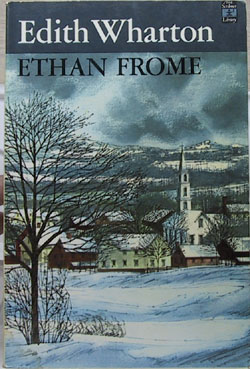
Review - Ethan Frome by Edith Wharton


Summary: (via Goodreads) Best known for her satirical depictions of the manners and mores of New York society, Edith Wharton shows her mastery of a far different milieu in this classic story of a farmer who is trapped in a loveless marriage to a tyrannical wife.

Review: Edith Wharton, was a woman born into great wealth who had a keen sense of how to create great fiction out of that which she saw in the social circles of the upper class. For this most part, her literary efforts worked out beautifully, endowing all generations past her time with glimpses of what once was through such classics as The House of Mirth, The Age of Innocence and The Buccaneers.
            In the novella Ethan Frome, Edith Wharton steps away from that which she knows (i.e., lavishness, propriety, the upper-class) and tries to examine life from the view point of someone located closer to the bottom of the social strata: Ethan Frome is a poor New England farmer who has been dealt a difficult hand in life in terms of love and money.
From a young age, Ethan had natural ability and curiosity that made him believe he could make something of himself, but an inevitable series of ill-fortunate events find him (at age 28) the owner of a failing estate and married to the sickly and wretched Zeena. Still, Ethan’s youth and strength, as well as his budding love interest in Zenna’s cousin, Mattie, keep his dreams of a better future alive despite his pitiable circumstances. Sadly, this being the tragic tale of a man who never got what he desired or deserved, it ends on a gloomy note which find our protagonist still tied to the estate and to Zeena, but this time, deprived of his health or any hope. 
I like the contrast Wharton creates between her three main characters, and the melodramatic events that ensue as their lives are intersected. Despite living in a small and sleepy New England town, Ethan, Zeena and Mattie, live lives filled with emotion and desires. Zeena is the oldest of the three; her poor health and general misfortune make her bitter and possessive. She is a villain, but not by choice. Mattie is quite different. She is young and naive and filled with romantic notions about life. She makes us think about how Zeena could have been were it not for her ill health. Ethan falls in the middle. A marriage contract binds him to Zeena, and his desire for youth attracts him to Mattie. Being that he’s near 30 years old, making a rash decision in picking either woman comes with lasting consequences for everyone. This is the tale of three people bound by love and a great deal of misfortune.  
            I’ve read some reviews of this book which criticize Wharton’s attempt at writing outside her scope of knowledge and attempting to penetrate the mindset of a class she knew very little about. Others point to the over-use of dramatics and gloom to make up for the lack of understanding. I would have to disagree. To me, the story’s preface serves as an explanation for all this. Ethan Frome has a fictitious preface, written in the form of an author’s note, which set-up for the rest of the story.  In it, Wharton explains that the writer of the story is a female journalist spending some months in a small town in New England. While working on a news story, this journalist runs paths with a disabled older man by the name of Ethan Frome, whose stoic nature captures her attention. Since she knows so little about him and basic propriety prevent her form asking too many questions, this journalist lets her imagination fill the gaps. What she comes up with it Ethan Frome, a tale of tragedy. It is this preface that gives meaning to why the story might be seen as watered-down and overly dramatic, because in essence, what we have in Ethan Frome is nothing more than the byproduct of a momentary lament of a writer whose imaginations was briefly captured by the sad face of a stranger.
            I never hesitate to pick-up one of Edith Wharton’s works when I need reminding what good literature feels like. 

LitSnit Verdict: B+

Monday, January 24, 2011

Review — Dash & Lily's Book of Dares

Synopsis (via Goodreads): “I’ve left some clues for you. If you want them, turn the page. If you don’t, put the book back on the shelf, please.” 

So begins the latest whirlwind romance from the New York Times bestselling authors of Nick & Norah’s Infinite Playlist. Lily has left a red notebook full of challenges on a favorite bookstore shelf, waiting for just the right guy to come along and accept its dares. 

But is Dash that right guy? Or are Dash and Lily only destined to trade dares, dreams, and desires in the notebook they pass back and forth at locations across New York? Could their in-person selves possibly connect as well as their notebook versions? Or will they be a comic mismatch of disastrous proportions? 

Rachel Cohn and David Levithan have written a love story that will have readers perusing bookstore shelves, looking and longing for a love (and a red notebook) of their own.

Review:  I was a big fan of Nick & Norah’s Infinite Playlist so when I saw Rachel Cohn and David Levithan were collaborating on a new he said/she said YA novel to say I was excited would be putting it mildly.  Dash and Lily covers a tumultuous time in a New Yorker’s life: December 21st – January 1st.  A time when tourists descend on the city in droves, it becomes impossible to take a step without being bombarded with rampant consumerism and unflappable cheer (and, this year, lots and lots of snow).  Some love it, some become, well, snarly.

Snarly is exactly how we meet Dash does at the start of the book.  He’s not a fan of Christmas and is counting the hours until the holidays are over.  Dash’s cynicism is counterbalanced by Lily’s innocent optimism.  She loves, no, adores, Christmas.  They meet through a red notebook in Strand, the famous bookstore housing 18 miles of books.  Lily’s original message in the notebook is bold and witty, yet we learn that she didn’t write it at all, but is a creation of her brother to get her to meet a guy. 

Lily is essentially the opposite of our (and Dash’s) first impression of her and as the book goes on, I kept kind of wishing I was following the girl I’d met in the notebook rather than the slightly immature, meek girl we were supposed to be falling in love with.  She was the kind of girl who’s sweet, but I couldn’t imagine actually spending more than a couple hours with because her perky nature would drive me insane.  Similarly, Dash’s hipster ways were kind of grating after a while.  His friend Boomer seemed like he was only there to inform us that he was actually a good guy and not perpetually “snarly.”  

While I liked most of the side characters (Lily’s aunt in particular is awesome), I didn’t get Boomer at all.  Was he challenged in some way?  How can he not have simple conversations without getting confused?  He was like a five-year-old stuck in a sixteen-year-old’s body.  I found myself getting distracted by worry for the kid, running around in New York City about to get mugged at any moment or get taken advantage of in some way, rather than invested in the budding romance.  Also of a concern:  the Macy’s Santa.  There’s a moment with Dash and Santa that Cohn and Levithan brush off as “huggy” which made me recoil and want to call To Catch a Predator. 

I kept expecting to relate to the characters like I did Nick and Norah, but it just didn’t happen.  I didn’t dislike them, really, but I just didn’t care much if they ended up together or not.  And because I couldn’t get invested in them, I also couldn’t understand how they were getting invested in each other.  They didn’t have much chemistry to speak of.  Yet, Cohn and Levithan’s writing is snappy and witty enough to keep me turning the page, wanting (but not eager) to see what happens next.  I don't think Christmas worked as a common denominator between the two characters like music did with Nick & Norah.  There was a certain amount of love and youthful adoration for something bigger than themselves that was missing.

I do, however, love the way they use New York to their advantage, finding all the nooks and cranies (and crazies) of the city and making you feel like you belong.  I hope they do another novel like this together because the small shout outs from Nick and Norah made my day.  I feel like their creating their own New York and I want to see more.

While I enjoyed the Christmas theme (any non-cheesy holiday books are few and far between), and I wish I had read this before Christmas instead of after, I feel like more dynamic characters might have made this a bit more enjoyable.  

Lit Snit Verdict: C+
That cover, on the other hand? A+

Thursday, January 20, 2011

Review - Juliet by Anne Fortier

Synopsis (via Goodreads): Twenty-five-year-old Julie Jacobs is heartbroken over the death of her beloved aunt Rose. But the shock goes even deeper when she learns that the woman who has been like a mother to her has left her entire estate to Julie’s twin sister. The only thing Julie receives is a key—one carried by her mother on the day she herself died—to a safety-deposit box in Siena, Italy.

This key sends Julie on a journey that will change her life forever—a journey into the troubled past of her ancestor Giulietta Tolomei. more

Review: A lush adventure/romance exploring the story that inspired Shakespeare's Romeo and Juliet. In alternating chapters, we meet a modern woman, Julie, who is searching for her family's history (and hoping for treasure too) and meeting friends and enemies along the way, and we hear from Friar Lorenzo, Giulietta Tolomei and Romeo Marescotti as their story unfolds in 1340 AD (similar to Shakespeare’s but with some differences).

Both of these tales take place not in "fair Verona" but in the equally gorgeous Siena, Italy. Settings don’t get much better than this. Siena is a city rich with history and beauty, the sort of city you fall in love with and never want to leave. In fact, the author’s bio on the back flap of the book says she wrote the book for her mother who “considered Verona as her true home until she discovered Siena.” In this book, we tour Siena with Julie, visiting cathedrals and piazzas and concert halls. We learn about the vast underground aqueducts and the palio (a traditional medieval horse race). Gorgeous.

In this book, you never quite know who to trust (which does work against character development a bit). Feuding households and curses on both houses have spilled over from the 1340s to modern times, and Julie (who learns her birth name is actually Giulietta Tolomei) has to figure out what happened to the original Giulietta, what really happened to her parents, and who she should trust now as she uncovers the secrets of Romeo and Giulietta.

The plot's a bit clumsy at times (with convenient coincidences and characters who could have saved a lot of trouble by just explaining things in the first place), but it’s fun anyway. Though for a tale that rewrites the origin of Shakespeare's Romeo & Juliet, I could have done with a little less consensus among the characters that our modern Julie is pretty much the Juliet simply because she is the first of the female line in 300 years to have the same name as the original Giulietta. As in, since she's “Juliet”, she must be destined for a man named Romeo who is also descended from the original Romeo. But ... didn't "Romeo & Juliet" itself say, "what's in a name?”

Bottom line: it’s a fun action/adventure/romance that retells a classic story.

Lit Snit Verdict: B+

Wednesday, January 19, 2011

Review: The Red Tree by Caitlin Kiernan

Synopsis (via Goodreads): Sarah Crowe left Atlanta, and the remnants of a tumultuous relationship, to live alone in an old house in rural Rhode Island. Within its walls she discovers an unfinished manuscript written by the house’s former tenant—a parapsychologist obsessed with the ancient oak growing on a desolate corner of the property. And as the gnarled tree takes root in her imagination, Sarah risks her health and her sanity to unearth a revelation planted centuries ago…

Review: Caitlin Kiernan’s novel, The Red Tree, is a fantasy thriller about the hypnotizing mysteries of an old and decrepit estate located in the backwoods of New England. Written in the form of a diary penned the estate’s newest tenant, Sarah Crowe (a published author and a bit of a recluse), it takes us through Sarah’s daily ruminations as she slowly falls under the spell of the strangeness that surrounds her.
            In the opening pages of her diary, Sarah recollects the reasons for her relocation. Having just ended a tumultuous relationship with her girlfriend, she’s drawn to the quite peacefulness of rural New England, the perfect place to finish a book she’d been commissioned to write. While trying to find inspiration for her story, Sarah begins to explore the house’s hidden corners and stumbles upon an old manuscript written by a former tenant. This manuscript is a collection of all the odd and unexplained tragic events that have occurred on the estate over the years. Despite the stories’ dark and eerie nature, Sarah’s interest in what she’s reading grows. The more spooked she gets, the greater her affinity becomes.  
            Seemingly out of nowhere, Sarah’s solitude is interrupted when another tenant moves in. Constance immediately changes the story’s dynamic and we are struck by how abnormally knowledgeable she is about the house, the old manuscript, and about Sarah herself, more knowledgeable than a mere stranger could ever possibly be. Her disruptive presence enhances the eeriness of the story.
It is around this point that Sarah’s narration also begins to change, shifting from a routine log of events into a less refined and sometimes disconnected rambling. New information surfaces about a mental health disorder. A more complete picture is formed about what happened between Sarah and her former girlfriend. The narration becomes neurotic and patchy, quickly condemning Sarah’s credibility. Soon we start to question whether what she’s telling us is still the truth and not a spin-off of the fictitious work she has been so hard pressed to finish.
            Overall, The Red Tree is very complex and suspenseful. Having a narrator that cannot be trusted was a unique reading experience. Even now, a few months after I’ve finished the book, I still don’t know what to make of the whole story. The best I can do is say that it reads like a David Lynch film: revisiting it again and again might lead to multiple interpretations, yet something about the story will forever remain elusive and misunderstood.

LitSnit Verdict: B

Monday, January 17, 2011

Review — The Maze Runner by James Dasher

Synopsis (via Goodreads): Imagine waking up one day in total darkness, unsure of where you are and unable to remember anything about yourself except your first name. You're in a bizarre place devoid of adults called the Glade. The Glade is an enclosed structure with a jail, a graveyard, a slaughterhouse, living quarters, and gardens. And no way out. Outside the Glade is the Maze, and every day some of the kids -- the Runners -- venture into the labyrinth, trying to map the ever-changing pattern of walls in an attempt to find an exit from this hellish place. So far, no one has figured it out. And not all of the Runners return from their daily exertions, victims of the maniacal Grievers, part animal, part mechanical killing machines.

Thomas is the newest arrival to the Glade in this
Truman-meets-Lord of the Flies tale. A motley crew of half a dozen kids is all he has to guide him in this strange world. As soon as he arrives, unusual things begin to happen, and the others grow suspicious of him. Though the Maze seems somehow familiar to Thomas, he's unable to make sense of the place, despite his extraordinary abilities as a Runner. What is this place, and does Thomas hold the key to finding a way out?

In
The Maze Runner, Dashner has crafted a creative and engaging novel that's both mysterious and thought provoking.

Review:  This is one of those books that it’s hard for me to not to associate with another book.  The first time I heard about The Maze Runner it was along with someone saying “if you liked Hunger Games you’ll love it.”  So, maybe I was expecting too much when I excitedly dove into this one.  It’s not a bad book, by any means.  It was just one of those ones that wasn’t for me.

I don’t think it helped that I had trouble envisioning this maze in my mind.  There seemed to be a lot of conflicting descriptions, but I have a tendency to read fast and miss details so that just might be on me.  Same with the Grievers.  So, they’re Swiss-army slugs?  What?!

It also didn’t help that there was just so much stuff to explain that I went a bit crossed-eyed for a few pages and just stopped caring.  Characters seemed to revolve around Thomas, just telling him what was going on, what had been happening, and to just STOP ASKING QUESTIONS.  That started to irritate me a lot.  This sentiment seemed to be said over and over again, and you’re constantly expecting the payoff of, “uh, no, asking questions is what’s going to save your ass.”  And it did, kind of, but was really more stumbled upon than the result of Thomas’ curiosity.

While I did stay up late because the pacing picked up toward the end and I just wanted to finish, the plot seemed to truck along with the steady pace of “action, exposition, action, action, exposition, more exposition, really, there’s a lot of exposition we need to tell you about, crazy action, cliffhanger.”  I felt like this book had a lot of “tell” in terms of the world and the rules of it all and not a whole lot of “show” (and definitely not a whole lot of character development).  Dashner also created his own language to get around those pesky kids swearing all the time, but it seemed so forced and never really had much context so it eventually ended up distracting me more than anything.

My main issue, and what I have to say The Maze Runner lacked, compared to the Hunger Games trilogy (sorry, can’t help it, I’m comparing), was heart.  I just didn’t find myself caring for any of the characters much.  We saw them do a whole lot of cool stuff, but I didn’t feel like I really knew them, so when characters you should care about is in mortal danger, I just sort of shrugged and turned the page.  That being said, there was a nice cliffhanger that has me leaning towards picking up the next in the series and the overall conspiracy and reasons behind the maze are interesting and could be really cool.

Lit Snit Verdict: C

Thursday, December 30, 2010

Review: In The Time of Butterflies--Julia Alvarez

Synopsis: From the author of How the Garcia Girls Lost Their Accents comes this tale of courage and sisterhood set in the Dominican Republic during the rise of the Trujillo dictatorship. A skillful blend of fact and fiction, In the Time of the Butterflies is inspired by the true story of the three Mirabal sisters who, in 1960, were murdered for their part in an underground plot to overthrow the government. Alvarez breathes life into these historical figures--known as "las mariposas," or "the butterflies," in the underground--as she imagines their teenage years, their gradual involvement with the revolution, and their terror as their dissentience is uncovered.
Alvarez's controlled writing perfectly captures the mounting tension as "the butterflies" near their horrific end. The novel begins with the recollections of Dede, the fourth and surviving sister, who fears abandoning her routines and her husband to join the movement. Alvarez also offers the perspectives of the other sisters: brave and outspoken Minerva, the family's political ringleader; pious Patria, who forsakes her faith to join her sisters after witnessing the atrocities of the tyranny; and the baby sister, sensitive Maria Teresa, who, in a series of diaries, chronicles her allegiance to Minerva and the physical and spiritual anguish of prison life.

Review:  What an incredibly moving story.

As I stated a couple of months ago, I've been having trouble finding the time to complete books these days due to a crazy and chaotic schedule (and I know most of you can relate!). So what a joy it was, when I finally found the time to get back into reading, for my first book to be this one.

Alvarez, through 4 completely distinct perspectives, tells us this fascinating story of four incredibly strong women fighting for a cause they truly believed in; sacrificing their lives for the good of their country and standing against a government that showed no remorse in getting revenge against those who disputed it.

This book, a work of historical fiction, gives insight into the bleak side of Dominican history through the Mirabel sisters, whom (and Alvarez notes this herself) have been praised and revered they've become somewhat of a myth.  (They were real women and I applaud Alvarez for taking these women and giving us the, albeit fictional, human side of these women making them relatable.) Alvarez presents this story in a way that is simple yet fascinating.


I loved this book. I loved the story of these women and it made me wonder if I necessarily had the strength or courage to do something along the lines of the Mirabel sisters. All in all, definitely an entertaining read.

Grade: A

Monday, December 13, 2010

Review — Five Flavors of Dumb by Antony John

Synopsis (Goodreads):  The Challenge: Piper has one month to get the rock band Dumb a paying gig.
The Deal: If she does it, Piper will become the band's manager and get her share of the profits.

The Catch: How can Piper possibly manage one egomaniacal pretty boy, one talentless piece of eye candy, one crush, one silent rocker, and one angry girl? And how can she do it when she's deaf?

Piper can't hear Dumb's music, but with growing self-confidence, a budding romance, and a new understanding of the decision her family made to buy a cochlear implant for her deaf baby sister, she discovers her own inner rock star and what it truly means to be a flavor of Dumb.

Review:  I first heard about Five Flavors of Dumb over at Capillya's blog, thatcovergirl.  This was one of those books that I picked up purely for the cover.  It sounded interesting and the cover was pretty badass so I thought I'd give it a try.  However, unlike Her and Me and You, this one delivered with the story as well as the cover.

I skimmed the synopsis so quickly when I was looking into this book that I didn't even realize Piper was deaf until I picked it up and started reading.  You quickly realize Piper's deafness isn't a disability or hinderance, but it's a part of her.  John wove her deafness into Piper's character, without falling back on any kind of cheesiness or cliches.  You never forget that Piper is deaf, but it's not who she is, just another aspect of her personality.

Piper is one of those characters that you just kind of wish were real so you could hang out and become BFFs.  There's something inspiring about watching her evolve from a scared, pseudo-wallflower to the leader of a rock band.  As much as I don't want to admit it, I was surprised when I realized that this book was written my a guy.  I know, I know, a good writer can write any gender, so I should know better.  John created a fantastic, complex, strong female character that rivals, in my mind, Katniss, Buffy, and Jessica Darling.  There were moments when I wanted to shake her (mostly when it came to her utter blindness to the guy who was in love with her), but I couldn't help but love her.  There's a great moment with the band's "mentor," Baz, impersonating her father that had me laughing out loud and solidified Piper's position as favorite female character of the year.

I was impressed how well the other characters were complete, well-rounded characters.  Well, except for Will and Josh, I would have liked to see a little more of who they were outside of the band.  Josh was a bit one-note.  But Piper's parents were particularly well done.  They weren't necessarily perfect, but they weren't terrible parents either.  You could see that they were doing the best they could, and sometimes they made mistakes.  While I seriously hated her father though most of the book, his character had a nice progression.  The cynic in my wonders if he would have such a profound turnaround, but my heart is a black shriveled up husk so I'm going to go with it.  (Kidding...it's only mildly withered)

There's also real reverence for music throughout the book.  Though Piper can't totally hear their music, she finds inspiration from Kurt Cobain and Jimi Hendrix.  She's inspired by who they were, how they came to be musicians, and how they affected millions of people as much as any of us can be inspired by the music they made.  In these moments of music history, Dumb became much more than a book about a band trying to make it.  It was about the importance of music as, not just an aspect pop culture, but an aspect of history.

Also, I can't end my review without giving some love to Ed Chen.  If I ever complain that fictional nice guys are boring, remind me of Ed Chen.  Adorable, adorable Ed Chen (See also: Piper's brother, Finn).  Score one for the nice guys, Ed Chen.  (I think I just like saying "Ed Chen")

Review: A-

Tuesday, December 7, 2010

Review - How to Become a Famous Writer Before You’re Dead by Ariel Gore

Review:
Whew! It’s December and NaNoWriMo is over! OVER! If that challenge has taught me anything, it’s that writing a complete novel might be one of the toughest things to accomplish in life All authors whose work I has the chance of reading this year, including the ones I didn’t particularly enjoy (yes, I’m thinking of you, Liz Berry) deserve a hardy pat on the back for their achievement!

Now, should you be an individual who (unlike me) earnestly undertook the NaNoWriMo challenge and are well on your way to completing your first novel, but have never actually published anything before, you might be overwhelmed by the thought of the hurdles to come in transforming that NaNoWriMo baby into a tangible book.

It was with this in mind that I decided to read Ariel Gore’s writers’ self-help book entitled How to Become a Famous Writer Before You’re Dead, in which she shares the secrets to publishing superstardom. Gore’s main argument is that the secret to success in the novel-wring world has more to do with one’s conviction than raw literary talent, and that we’re all capable of improving ourselves in both areas with a little discipline. Gathering an assortment of tips she has learned through her own journey as a writer and literary coach, she’s manages to create an excellent argument for writing. If you ever gave up on your dream of becoming a famous novelist because of age, time constraints or lack of ideas, you might find yourself inspired by Gore’s own success story. She made it while being a teenage single mother! And really, what’s tougher than that?

Interspersed in Gore’s narrative are snippets of advice from a few prominent literary figures from a variety of literary niches. Although they all have their own story to tell about what lead them to success, the key terms of discipline and self-confidence permeate throughout everyone’s advice. You might even be surprised by how basic yet profound their writing tips and recommendations are.  

Bottom line, Gore’s voice is filled with so much energy that even if you never dreamed of writing a book, you might get sucked into believing that you could and perhaps even should! I really enjoyed How to Become a Famous Writer Before You’re Dead. Despite having little aspiration of writing a book myself, Gore’s word were compelling enough to make me add “write a novel” as a goal on my list of things-to-do-before-I-die.

LitSnit Verdict: A