Showing posts with label B-rated. Show all posts

Monday, February 14, 2011

Review - Mad Love by Suzanne Selfors


Summary (via Goodreads): When you're the daughter of the bestselling Queen of Romance, life should be pretty good. But 16-year-old Alice Amorous has been living a lie ever since her mother was secretly hospitalized for mental illness. After putting on a brave front for months, time is running out. The next book is overdue, and the Queen can't write it. Alice needs a story for her mother—and she needs one fast.

That's when she meets Errol, a strange boy who claims to be Cupid, who insists that Alice write about the greatest love story in history: his tragic relationship with Psyche. As Alice begins to hear Errol's voice in her head and see things she can't explain, she must face the truth—that she's either inherited her mother's madness, or Errol is for real.


I must not have done more than skim the summary of this book, because when I picked it up from the library last week, the first thing I noticed was that the heart-spiral on the cover is filled with the phrase "I don't believe in Cupid" over and over, and I laughed and thought, "Is Cupid going to be in this story?"

Yes. Yes, he is. And Cupid wants his story told.

So, the fact that this is a Cupid story and today is Valentine's Day is pure coincidence, I swear.

Anyway, on to the review:

Alice, our main character, has enough going on in her life that this strange guy named Errol claiming to be Eros/Cupid/God-of-Love has trouble grabbing her attention. First, her mom's in a hospital for the mentally ill. That alone is enough to ruin a girl's summer, but Alice can't tell anyone outside of a small clan of trusted neighbors the truth, because her mom? She has a title of her own: Queen of Romance. The fans and publishing house can't know that their favorite romance author is sick. So Alice steps in, signing books, fending off questions about when the next book will be finished, telling everyone her mom is "overseas." When the hospital bills can't be paid, Alice puts her life on hold (even telling her crush it's too complicated right now) to step into her mother's shoes, trying to write her mom's "untitled work in progress."

This book deals with some tough issues, but the over-all tone of the book is light. Cupids start appearing everywhere in Alice's life, figurines, pictures, and Cupid himself. We even get to witness the knock-you-off-your-feet effects of Cupid's arrows.

There was a lot going on in this story. Alice's "family", her neighbors: Ms. Bobot, Ms. Bobot's granddaughter Realm, Reverend Ruttles, and Archibald, each had their own subplots, and Errol had his story of his one and only love, Psyche, to tell. This made some of the subplots seem rushed. I wanted to spend more time with the adult's stories. I wanted Errol's story fleshed out more (as it was, his tale of Psyche had barely more detail than the original myth). But what was there was good.

Overall, this was a fun read, and met my expectations (even though Cupid was a surprise... next time, I'll read the second paragraph of the description).

Lit Snit Verdict: B

Friday, February 11, 2011

Review - Delirium by Lauren Oliver


Summary (from Goodreads): Before scientists found the cure, people thought love was a good thing. They didn’t understand that once love -the deliria- blooms in your blood, there is no escaping its hold. Things are different now. Scientists are able to eradicate love, and the government’s demands that all citizens receive the cure upon turning eighteen. Lena Holway has always looked forward to the day when she’ll be cured. A life without love is a life without pain: safe, measured, predictable, and happy.

But with ninety-five days left until her treatment, Lena does the unthinkable: She falls in love


I had mixed feelings about this book before I even started reading it. The good: It's by Lauren Oliver, the author of "Before I Fall." I love the depth she brings to her characters. The bad: It's another dystopia book. Normally, I love a good dystopia story, but after the last one I read I was wary of the entire genre (Ally Condie’s “Matched” just didn’t work for me).

The premise: Love has been identified as a disease, and now the cure is mandatory. The cure isn’t safe for under-eighteens, so society is not completely safe from "amor deliria nervosa". There are patrols and raids, looking for signs of resistance and uncured kids who might be infected. You better watch what you say, even to your best friend, because you don’t know if you’re being watched. You don't want to be thought of as a "sympathizer". Sympathizers are executed.

Seeing the world from Lena's perspective, I can understand why she feels comfort in the idea of the cure. With the cure, all the awkwardness and emotional rollercoasters of being a teenager are instantly wiped away, leaving behind a calmer, matured version of yourself, safe from the dangers of deliria, which can kill you and you won't even care.

But I felt like I was missing something in why the country had that violent switch-over to an oppressive 1984-esque government with a too-harsh penal system. Sure, they found deliria to be the cause of many diseases, but I just had trouble believing that the government would then force everyone to be cured, when really I would think only the most heart-broken/grief-stricken people would find the idea of curing love appealing. Maybe it will be explained more in the sequels.

In a lot of ways, the life of a teenager (pre-cure) is pretty familiar: School bullies and best friends, curfews, summer jobs, and even first loves. Yes, Lena catches deliria. She’s falling in love for the first time and, no, she doesn't even care if it'll kill her.

It's worth reading for the characters; I do love Lauren Oliver's writing style. If you can ignore the nagging question “but why would they want to cure love?” then it’s a good read. I liked the duel perspective we got with Lena’s best friend, Hana, who is the opposite of Lena in a lot of ways, and is the first to question the cure. It’s Hana who whispers to her, “You know you can’t be happy unless you’re unhappy sometimes, right?” and starts Lena down a path that will lead her to question her entire worldview.

Lit Snit Verdict: B-

Tuesday, January 25, 2011

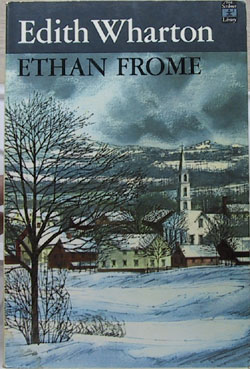
Review - Ethan Frome by Edith Wharton


Summary: (via Goodreads) Best known for her satirical depictions of the manners and mores of New York society, Edith Wharton shows her mastery of a far different milieu in this classic story of a farmer who is trapped in a loveless marriage to a tyrannical wife.

Review: Edith Wharton, was a woman born into great wealth who had a keen sense of how to create great fiction out of that which she saw in the social circles of the upper class. For this most part, her literary efforts worked out beautifully, endowing all generations past her time with glimpses of what once was through such classics as The House of Mirth, The Age of Innocence and The Buccaneers.
            In the novella Ethan Frome, Edith Wharton steps away from that which she knows (i.e., lavishness, propriety, the upper-class) and tries to examine life from the view point of someone located closer to the bottom of the social strata: Ethan Frome is a poor New England farmer who has been dealt a difficult hand in life in terms of love and money.
From a young age, Ethan had natural ability and curiosity that made him believe he could make something of himself, but an inevitable series of ill-fortunate events find him (at age 28) the owner of a failing estate and married to the sickly and wretched Zeena. Still, Ethan’s youth and strength, as well as his budding love interest in Zenna’s cousin, Mattie, keep his dreams of a better future alive despite his pitiable circumstances. Sadly, this being the tragic tale of a man who never got what he desired or deserved, it ends on a gloomy note which find our protagonist still tied to the estate and to Zeena, but this time, deprived of his health or any hope. 
I like the contrast Wharton creates between her three main characters, and the melodramatic events that ensue as their lives are intersected. Despite living in a small and sleepy New England town, Ethan, Zeena and Mattie, live lives filled with emotion and desires. Zeena is the oldest of the three; her poor health and general misfortune make her bitter and possessive. She is a villain, but not by choice. Mattie is quite different. She is young and naive and filled with romantic notions about life. She makes us think about how Zeena could have been were it not for her ill health. Ethan falls in the middle. A marriage contract binds him to Zeena, and his desire for youth attracts him to Mattie. Being that he’s near 30 years old, making a rash decision in picking either woman comes with lasting consequences for everyone. This is the tale of three people bound by love and a great deal of misfortune.  
            I’ve read some reviews of this book which criticize Wharton’s attempt at writing outside her scope of knowledge and attempting to penetrate the mindset of a class she knew very little about. Others point to the over-use of dramatics and gloom to make up for the lack of understanding. I would have to disagree. To me, the story’s preface serves as an explanation for all this. Ethan Frome has a fictitious preface, written in the form of an author’s note, which set-up for the rest of the story.  In it, Wharton explains that the writer of the story is a female journalist spending some months in a small town in New England. While working on a news story, this journalist runs paths with a disabled older man by the name of Ethan Frome, whose stoic nature captures her attention. Since she knows so little about him and basic propriety prevent her form asking too many questions, this journalist lets her imagination fill the gaps. What she comes up with it Ethan Frome, a tale of tragedy. It is this preface that gives meaning to why the story might be seen as watered-down and overly dramatic, because in essence, what we have in Ethan Frome is nothing more than the byproduct of a momentary lament of a writer whose imaginations was briefly captured by the sad face of a stranger.
            I never hesitate to pick-up one of Edith Wharton’s works when I need reminding what good literature feels like. 

LitSnit Verdict: B+

Thursday, January 20, 2011

Review - Juliet by Anne Fortier

Synopsis (via Goodreads): Twenty-five-year-old Julie Jacobs is heartbroken over the death of her beloved aunt Rose. But the shock goes even deeper when she learns that the woman who has been like a mother to her has left her entire estate to Julie’s twin sister. The only thing Julie receives is a key—one carried by her mother on the day she herself died—to a safety-deposit box in Siena, Italy.

This key sends Julie on a journey that will change her life forever—a journey into the troubled past of her ancestor Giulietta Tolomei. more

Review: A lush adventure/romance exploring the story that inspired Shakespeare's Romeo and Juliet. In alternating chapters, we meet a modern woman, Julie, who is searching for her family's history (and hoping for treasure too) and meeting friends and enemies along the way, and we hear from Friar Lorenzo, Giulietta Tolomei and Romeo Marescotti as their story unfolds in 1340 AD (similar to Shakespeare’s but with some differences).

Both of these tales take place not in "fair Verona" but in the equally gorgeous Siena, Italy. Settings don’t get much better than this. Siena is a city rich with history and beauty, the sort of city you fall in love with and never want to leave. In fact, the author’s bio on the back flap of the book says she wrote the book for her mother who “considered Verona as her true home until she discovered Siena.” In this book, we tour Siena with Julie, visiting cathedrals and piazzas and concert halls. We learn about the vast underground aqueducts and the palio (a traditional medieval horse race). Gorgeous.

In this book, you never quite know who to trust (which does work against character development a bit). Feuding households and curses on both houses have spilled over from the 1340s to modern times, and Julie (who learns her birth name is actually Giulietta Tolomei) has to figure out what happened to the original Giulietta, what really happened to her parents, and who she should trust now as she uncovers the secrets of Romeo and Giulietta.

The plot's a bit clumsy at times (with convenient coincidences and characters who could have saved a lot of trouble by just explaining things in the first place), but it’s fun anyway. Though for a tale that rewrites the origin of Shakespeare's Romeo & Juliet, I could have done with a little less consensus among the characters that our modern Julie is pretty much the Juliet simply because she is the first of the female line in 300 years to have the same name as the original Giulietta. As in, since she's “Juliet”, she must be destined for a man named Romeo who is also descended from the original Romeo. But ... didn't "Romeo & Juliet" itself say, "what's in a name?”

Bottom line: it’s a fun action/adventure/romance that retells a classic story.

Lit Snit Verdict: B+

Wednesday, January 19, 2011

Review: The Red Tree by Caitlin Kiernan

Synopsis (via Goodreads): Sarah Crowe left Atlanta, and the remnants of a tumultuous relationship, to live alone in an old house in rural Rhode Island. Within its walls she discovers an unfinished manuscript written by the house’s former tenant—a parapsychologist obsessed with the ancient oak growing on a desolate corner of the property. And as the gnarled tree takes root in her imagination, Sarah risks her health and her sanity to unearth a revelation planted centuries ago…

Review: Caitlin Kiernan’s novel, The Red Tree, is a fantasy thriller about the hypnotizing mysteries of an old and decrepit estate located in the backwoods of New England. Written in the form of a diary penned the estate’s newest tenant, Sarah Crowe (a published author and a bit of a recluse), it takes us through Sarah’s daily ruminations as she slowly falls under the spell of the strangeness that surrounds her.
            In the opening pages of her diary, Sarah recollects the reasons for her relocation. Having just ended a tumultuous relationship with her girlfriend, she’s drawn to the quite peacefulness of rural New England, the perfect place to finish a book she’d been commissioned to write. While trying to find inspiration for her story, Sarah begins to explore the house’s hidden corners and stumbles upon an old manuscript written by a former tenant. This manuscript is a collection of all the odd and unexplained tragic events that have occurred on the estate over the years. Despite the stories’ dark and eerie nature, Sarah’s interest in what she’s reading grows. The more spooked she gets, the greater her affinity becomes.  
            Seemingly out of nowhere, Sarah’s solitude is interrupted when another tenant moves in. Constance immediately changes the story’s dynamic and we are struck by how abnormally knowledgeable she is about the house, the old manuscript, and about Sarah herself, more knowledgeable than a mere stranger could ever possibly be. Her disruptive presence enhances the eeriness of the story.
It is around this point that Sarah’s narration also begins to change, shifting from a routine log of events into a less refined and sometimes disconnected rambling. New information surfaces about a mental health disorder. A more complete picture is formed about what happened between Sarah and her former girlfriend. The narration becomes neurotic and patchy, quickly condemning Sarah’s credibility. Soon we start to question whether what she’s telling us is still the truth and not a spin-off of the fictitious work she has been so hard pressed to finish.
            Overall, The Red Tree is very complex and suspenseful. Having a narrator that cannot be trusted was a unique reading experience. Even now, a few months after I’ve finished the book, I still don’t know what to make of the whole story. The best I can do is say that it reads like a David Lynch film: revisiting it again and again might lead to multiple interpretations, yet something about the story will forever remain elusive and misunderstood.

LitSnit Verdict: B

Tuesday, November 16, 2010

Review - Slacker Girl by Alexandra Koslow

Summary: (via Goodreads) Jane Cooper's lifestyle is unfamiliar to most of her fellow workaholic New Yorkers. When she is not putting in the absolute minimal time at her job as a relationship manager for an investment firm, she's most likely to be found at her favorite cafe, staring into space, obsessively creating embroidery art, hanging out with friends, listening to music, and/or drinking coffee. In truth, Jane believes that corporate life was unfairly glamorized by "propaganda" films of the 1980s such as Working Girl or Secret to My Success. She dodges the effects of these programs by working as little as possible.

Review: I can say one thing for sure, this book is not for everyone. Although it is a heck of a fun read, it does lack a bit of sophistication, even for the chick-lit novel. The main character, Jane, is drawn up as the ultimate slacker: she wants to work as little as possible and enjoy a leisurely life type of lifestyle as much as possible. But how does that work in NYC without the risk of homelessness? Well, Jane has a good (if not entirely plausible) answer, and she meticulously walks you through the process of acquiring what she’s got. In brief, this involves a lot of good budgeting and some very intricate work-time/play-time maneuvers.
Her narrative has it charms; her reasons for striving to be a twenty-something slacker girl are not entirely unfounded (and I’m saying this as a New Yorker who has some first hand experience at the competitive professional nature of the people that inhibit this city.) But somewhere between trying to create a really fun, really light story about a girl who’s chasing personal gratification over professional success, Koslow doesn’t strike gold. When we first encounter Jane, she seems like an intelligent character with philosophically sound leisurely pursuits that might make you envy her bold decisions in life. But as the story proceeds and the circumstance of her life become naturally more complicated, Jane, in conjunction with her leisure lifestyle motto, starts to make a lot of careless and silly decisions that just make you question her mental capacity for handling life. So, before you decide to read this book, you should ask yourself if you’re interested in reading about a woman who tries very hard to make the mentality of a college party animal work for her at age 28. The story is a journey nonetheless, and Jane does mature a bit before the story comes to an end.
    What I absolutely adored about Slacker Girl was the leading male interest. Jane is a slacker and a bit of an airhead in many departments including romance. However, Ray, the guy who eventually becomes Jane’s The One is so great, it was worth reading through all the not-so-enjoyable sections of the book. I don’t know what I look forward to in my perfect fictional leading man, but this guy gets pretty close. I’m not typically interested in the macho, brooding tough guys or bad boys with a chip on their shoulder. I like those other rarer ones, who are quiet, and awkward and stumble over theirs words every once in a while. Ray is definitely my second favorite leading male character in all books I’ve read this year (the number one spot is currently occupied by Get Lucky’s Everett Thompson.)

LitSnit Verdict: B (C for overall story + A for romance)

Tuesday, November 9, 2010

Review - Wicked Appetite by Janet Evanovich

Summary: (via goodreads) Seven Stones of Power. No one knows when they were created or by whom, each said to represent one of the Seven Deadly Sins.
For centuries, treasure hunters have been eager to possess the stones, undeterred by their corrupting nature. The list is long -- Genghis Khan, Alexander the Great, Napoleon, to name a few. Now the Stones have found their way to Salem, Massachusetts, and so has Gerwulf Grimoire, adding himself to this rogues' gallery of power seekers. He's an uncommonly dangerous man, with a hunger for the forbidden, and a set of abilities that are way beyond ordinary. Abilities that he feels entitle him to possess anything he might desire.
That would include Elizabeth Tucker, the woman he needs to find the Stones. She's freshly transplanted from New York City to Boston's North Shore. With a new job as pastry chef at Dazzle's bakery and an old house inherited from her Aunt Ophelia, her life is pretty much on track …until it's suddenly derailed by a guy named Diesel, a rude monkey, and a ninja cat.
Lizzy can handle the monkey and the cat. She's not sure about Diesel. He's offering up his own set of unusual talents, promising to protect her from Grimoire. The kind of protection that Lizzy suspects might involve guarding her body day and night.
The Seven Deadly Sins are pride, greed, lust, envy wrath, sloth and gluttony. That pretty much covers everything that is wicked. Diesel thinks it also pretty much covers everything that's fun. And Lizzy thinks Diesel and the Seven Deadly Sins cover everything her mother warned her about.


Review: It is no big secret that Janet Evanonich’s Stephanie Plum series was one of the reasons Janelle, Erin and I started this blog. And even though the three of us could never really agree on whether Stephanie was better off with Ranger or Morelli, their twisted love triangle was a heated topic of conversation many a time in our pre-LitSnit days. And so, when word got out that Evanovich had decided to start a brand new series, I knew I had to pay some sort of homage to Evanovich’s LitSnit contribution, and give her newest work a try.

Evanovich’s new series (I think it’s officially known as the Unmentionables Series) has a really simple premise. Our main heroine, Elizabeth, is a pastry chef living right outside of Salem Massachusetts. Her life is pretty dull and normal until she discovers that she has the supernatural ability to sense empowered objects. This ability, as it turns out, is of pivotal importance to two men: Diesel and Wulf, who are in the hunt for seven special stones (one for each of the seven deadly sins) that if combined have the ability to ravage the world. In Wicked Appetite, Lizzy’s mission is to discover stone #1, the one representing gluttony.

All in all, this Diesel series is Stephanie Plum all over again, except with an interesting supernatural twist, a new set of love interests, crazier mysteries to solve, and a monkey (instead of a hamster) as a pet. I don’t quite know whether these alternations are for the better, but they work. For the most part, as I was reading this book I got the sense that Evanovich had decided that solving mysteries with Stephanie as we knew her had gotten a little stale, and had tried to find a way to change as much as possible without loosing that same fun, funky and addictive core momentum she had going with the Plum books. Lizzy might be a little weaker as a character compared to Stephanie (I definitely missed some of that Jersey flare), but Evanovich manages to balance this out by giving greater focus on the male leading character, Diesel, who is just as charming as Morelli, if not more. Even the subtle supernatural additions, which I felt uncertain about in the beginning, worked out well and allowed for more playfulness in the story. 

Wicked Appetite is enjoyable because it’s entreating, and easy to read. A definite must for anyone who loved One for the Money, or anyone who has never tried reading something by Janet Evenovich but is up for a fun leisurely weekend read.

Lit Snit Verdict: B

Thursday, October 7, 2010

Review - French Kiss (Diary of a Crush, Book # 1) by Sarra Manning

Summary (via Goodreads): When Edie and Dylan first see each other in photography class, an instant attraction draws them together. But true love never does run smoothly—the two spar as much as they can’t keep their hands off each other. Then comes the college trip to Paris: Edie’s willpower will be tested to the limit! In between furious arguments and trips to the Louvre, the two share some passionate moments—but will it last?

Review: I liked this book. A lot.

I picked this up after reading through previous entries of Emily and Her Pink Little Notes and coming across her glowing review. I’m not necessarily a fan of books that are written in journal entries. I think it’s difficult, while reading them, to get a full understanding of the characters and relationships (that could just be me, though).

I didn’t find that to be the case here.

I think Manning did a wickedly awesome job of communicating Edie and Dylan’s dynamic through journal entries. I found myself laughing during her bratty moments & cringing during the embarrassing ones. I also found myself engrossed in their intimate moments. *swoon* Dylan, for all of his typical 19 year old boy craziness, is a keeper in my book. (At least for a girl of the age 16…at my age, I’d (hopefully) tell him to go kick rocks.) He’s the kind of boy you genuinely drool over in high school.

Speaking of intimacy, I enjoyed that Edie was the typical 16 year old girl who may have been in a little over her head, as it would have been easy to try to age her since she went to school with an older crowd. Edie is very firm on not wanting to have sex, as she feels she is not ready—she doesn’t allow herself to feel pressured & takes a mature stance by stating it upfront. This story has the right amount of “steam”, just enough to make your heart beat a little faster…definitely perfect for a 16 year old crowd but still entertaining to those older as well.

All in all, I found this book to be direct and refreshing, light and fun. I’m eagerly waiting on Kiss and Make Up (Diary of a Crush, Book 2) in the mail.

LitSnit Grade: B+

Monday, September 27, 2010

Review — Paranormalcy by Kiersten White

Summary (via Goodreads): Weird as it is working for the International Paranormal Containment Agency, Evie's always thought of herself as normal. Sure, her best friend is a mermaid, her ex-boyfriend is a faerie, she’s falling for a shape-shifter, and she’s the only person who can see through paranormals' glamours, but still. Normal.

Only now paranormals are dying, and Evie's dreams are filled with haunting voices and mysterious prophecies. She soon realizes that there may be a link between her abilities and the sudden rash of deaths. Not only that, but she may very well be at the center of a dark faerie prophecy promising destruction to all paranormal creatures.


Review:  There's been a lot of buzz about Paranormalcy around the YA blogosphere so I was pretty excited to get my hands on this one.  I didn't know quite what to expect; this premise could be either super cheesy or fantastic.  Will this book change paranormal YA forever?  No.  But it is an incredibly enjoyable read with a clever premise and Evie is a likable character who I'm looking forward to seeing more of.

My initial thought when I started reading was "this is like Hellboy if Hellboy was a teenage girl," and really, who doesn't want to see what Hellboy would be if he was a teenage girl (minus the sawed off horns and cigars).  I loved the entire concept of the IPCA and learning about their inner workings.  From gremlins to hags, White uses a lot of old myths and legends to populate her world.  The folklore geek in me was in heaven.  I can't help compare it with Lili St. Crow's Strange Angels series a little.  I think White's world sometimes lacked a little grittiness and realism that I loved in Strange Angels, but with things like fairies and unicorns (I hope we get a peek at those in future books) it's much more rooted in magic and it has a much lighter tone overall so it works.

I also appreciated how you really saw how sheltered Evie was, growing up in the IPCA, especially next to lend.  Her exuberance sometimes bordered on over-the-top, but it was all well in character.  She was bubbly and snarky without being annoying or bratty.  Her relationship with Lend develops naturally and they quickly become too adorable for words.

I've never been a huge fan of fairies so when I saw that one of the main characters was fey I kind of wrinkled my nose.  I read Melissa Marr's Wicked Lovely and wasn't overly impressed, but I think I'm just not into that avenue of paranormal YA.  However, there was something about Reth and White's description of fairies that finally made me realize how compelling they are.  Though I found myself kind of developing a crush on Reth, his abilities to control humans and the threat of being lost in his world forever totally freaked me out (and I tend to love amoral characters).  So thanks, to Kiersten for finally hitting home how frightening fairies are.  I can't wait to see more of Reth.

I do wish we got more time with the IPCA.  I found that world so interesting and compelling, I was a little disappointed they seem to be going in a different direction in future books.  I love the idea of this supernatural agency working behind the scenes of our world and wanted to see more.  Even still, I'll definitely be picking up book two in this fun, addictive series.

Lit Snit Verdict: B+

Monday, September 20, 2010

Review - Suicide Notes by Michael Thomas Ford

Summary: (via Goodreads) I'm not crazy. I don't see what the big deal is about what happened. But apparently someone does think it's a big deal because here I am. I bet it was my mother. She always overreacts.

Fifteen-year-old Jeff wakes up on New Year's Day to find himself in the hospital. Make that the psychiatric ward. With the nutjobs. Clearly, this is all a huge mistake. Forget about the bandages on his wrists and the notes on his chart. Forget about his problems with his best friend, Allie, and her boyfriend, Burke. Jeff's perfectly fine, perfectly normal, not like the other kids in the hospital with him. Now they've got problems. But a funny thing happens as his forty-five-day sentence drags on—the crazies start to seem less crazy.

Review: Suicide Notes is a book with a bold title that doesn’t shy away from dealing with a bold subject: suicide. Written as a 45 day log, it is the story of Jeff, a suicide-attemptee, who is enrolled in a teen suicide program after his parents discover him bleeding to death on his bedroom floor one New Year’s Eve.

Even though none of this is the least bit funny, Jeff’s narration, as he begins to describe life in the psychiatric unit, is surprisingly jolly. Instead of embarking on some morbid trip of self introspection, Jeff humors us with his observations of the strange and weird and wondrous people that surround him. Yeah, he might have tried to off himself just days ago, but in a psych ward that’s more or less the norm. As he sees it, an entirely different set of criteria must be applied before correctly labeling one as a “loony” (e.g., laughing at the idea of burning someone else to death in their sleep, and the like).

Eventually though, the dark sarcasm fades and is replaced by the deeper emotions that have been plaguing Jeff all this time. He is a kid with a secret, a secret that seems both frightening and shameful to him. And at fifteen, dealing with things you can’t change or know how to accept can feel impossible. Suicide seemed like a way out at some point, but now that Jeff has survived the attempt, he must once again face the issues as well as the consequences of what he has done.

As a character, Jeff can be described as scared and withheld. Some narrators are created to tell the reader everything about themselves in the first few pages of a book, while others hold back and need you to be there during the whole adventure before you can know them completely. Jeff is appropriately molded using the second technique and most of his confessions don’t happen until the second half of the story. Not unlike a new friendship, you have to experience enough with him to finally earn his trust.

My favorite part of the story is the insight into the parent-child dynamic shifts that happen after a suicide attempt. No one would argue the difficulty in facing your loved ones after making such a decision about your future. Jeff is forced to deal with this during several program-designated family sessions, where parents and child share feelings about what has happened. These sessions were difficult and emotional and as realistic as I can imagine them being. Jeff’s mother and father were authentic in the sorrow they felt over their underrepresented love for Jeff and their general cluelessness in understanding this quickly maturing version of him.

The issue of suicide isn't easy to handle because of all the blame and the hurt and the emotions that must be described. Michael Thomas Ford writes compellingly about all these, while also injecting the right amount of hopefulness and humor.

Lit Snit Verdict: B

Monday, September 6, 2010

Review — Waking the Witch by Kelley Armstrong

Summary (via Goodreads): The orphaned daughter of a sorcerer and a half-demon, Savannah is a terrifyingly powerful young witch who has never been able to resist the chance to throw her magical weight around. But at 21 she knows she needs to grow up and prove to her guardians, Paige and Lucas, that she can be a responsible member of their supernatural detective agency. So she jumps at the chance to fly solo, investigating the mysterious deaths of three young women in a nearby factory town as a favor to one of the agency's associates. At first glance, the murders look garden-variety human, but on closer inspection signs point to otherworldly stakes.


Soon Savannah is in over her head. She's run off the road and nearly killed, haunted by a mystery stalker, and freaked out when the brother of one of the dead women is murdered when he tries to investigate the crime. To complicate things, something weird is happening to her powers. Pitted against shamans, demons, a voodoo-inflected cult and garden-variety goons, Savannah has to fight to ensure her first case isn't her last. And she also has to ask for help, perhaps the hardest lesson she's ever had to learn.

Review: As I said last week I’m a big fan of Kelley Armstrong, particularly her ability to create realistic, strong female characters. I don’t adore every single heroine she’s introduced in her Otherworld series (like I said Elena, her original protagonist of the series is still my favorite), but I know each installment will be a fun, thrilling ride.

Having first met Savannah as a pre-teen in Kelley Armstrong’s Dime Store Magic, I was surprised to see she was already 21 (and then I felt a little old because Armstrong won’t “soap opera age” her characters and it really had been that long since I’d read Dime Store Magic). I was a little hesitant because all I remembered about Savannah was that she was slightly bratty and came from quasi-evil parents.  Plus, while I enjoyed Paige's books, I always found Paige and her husband Lucas a little goody-goody and boring for me.  I never got all that attached to either of them.  I was pleasantly surprised to find grown-up Savannah a fantastic protagonist.

Having an incredibly varied cast of characters seems to allow Armstrong to tackle different genres within one series. Some deal with the underbelly of Hollywood, some with family (or werewolf pack) life, but Paige’s stories, and now Savannah’s, are hardboiled private investigator tales infused with a good dose of the supernatural.  I find myself getting bored with a lot of the books I read in mystery or suspense. I get antsy, like “get on with it already!” when the story slows and have been know to read the last page just so I know who the killer is (It's terrible, I know! Don’t judge me!). But Armstrong always keeps me engaged, caring more about the characters than the mystery so I stick with it.  Even better, Armstrong’s good at keeping the story moving. There’s never a slow moment and the twists she throws at the reader genuinely surprised me and kept me guessing until the very end.

What makes this book one of the top three in the Otherworld series though is Savannah. Smart and sassy, she’s incredibly fun and unpredictable. I liked her so much I could even deal with the motorcycle, which I found a little cliche.  I just feel like it screams "oh, look at me, I'm a badass and not a girly girl because I ride a motorcycle.  Aren't I different?," but, here, it worked.  There were a few moments that I stepped back and was like, “wait, she’s supposed to be 21?” because sometimes she seemed so much older, but there was a good balance of her vulnerability and brashness that reminded you Savannah is still young and inexperienced.  She makes mistakes a young adult would make, trying to prove that she's capable of doing it all herself.   

I was a little disappointed with her love interest(s), but I hope we’ll get more of that in Savannah’s next book. I’m not getting a whole lot of chemistry between her and Adam, who she’s supposedly in love with, but they didn’t get a whole lot of time together. This one didn’t deal much with her personal or home life, which was fine, but I wish we could see more of what happened between this book and the last time we saw Savannah.

Like most of Armstrong’s books, I’m waiting anxiously for the next installment of the series, especially since Kelley threw in a shocking twist at the very end that will definitely have some serious repercussions for Savannah.

I have to say, I may have a new favorite heroine in the Otherworld series...

Lit Snit Verdict: B+

Oh, and don't forget to vote for what book we'll be reading for the book club in October!  The poll is on the main page in the lower left-hand corner.

Thursday, August 26, 2010

Review - The Popularity Papers: Research for the Social Improvement and General Betterment of Lydia Goldblatt and Julie Graham-Chang by Amy Ignatow

Summary: (via Goodreads) Lydia Goldblatt and Julie Graham-Chang are best friends with one goal: to crack the code of popularity. Lydia’s the bold one: aspiring theater star, stick-fighting enthusiast, human guinea pig. Julie’s the shy one: observer and artist, accidental field hockey star, faithful recorder. In this notebook they write down their observations and carry out experiments to try to determine what makes the popular girls tick. But somehow, when Lydia and Julie try to imitate the popular girls, their efforts don’t translate into instant popularity. Lydia ends up with a bald spot, their parents won’t stop yelling, and Julie finds herself the number-one crush of Roland Asbjørnsen. Worse, they seem to be drifting farther and farther from their goal—and each other.

Review: Awesome! That’s all I have to say about the “Popularity Papers” by Amy Ignatow. It’s a children’s book, but one that even an adult can enjoy. Most simply described, it is a scientific approach to climbing the popularity ladder in the minds of two 10-year-old girls. The book is written entirely in the girls’ loopy and uneven script and is also illustrated by them! Very cute!


(image stolen from NYT article about the book)
It’s really funny and heartwarming, in a children’s book type of way. The thought process of these two characters (Lydia Goldblatt and Julie Graham-Chang) is perfect (and I do have some authority when I say this because I know a 5th grader or two.) They come up with some clever observations about popularity, and follow these up with ludicrous plans on how to apply what they learn on themselves. The outcomes are a mixture of success and failure, but neither girl dwells too much on their failures.

The two best parts of the book are the friendship between Lydia and Julie, which is really sweet and lovely and a genuine portrayal what best friends should be, and the family situations the girls are in: Lydia is raised by a single mother and Julie has two dads. The author doesn’t try to explain or rationalize their situations but somehow makes them completely natural and normal as the story progresses.

I have a nephew who is 10 years old and I sometimes read the books he reads (especially now in the summer months when he has vacation) so that we can discuss them together…he is very bright! But I know that it can sometimes be challenging to entice a kid his age to read. This book, although clearly geared towards girls and not something he might be interested in, uses brilliant visual techniques to pull you in (very similar to the ones utilized in the Wimpy Kid series) and I think it would really interest someone his age. Heck, I really got into it myself.

Lit Snit Verdict: B

Tuesday, August 17, 2010

Review - If I Stay by Gayle Forman

Summary: (via back cover) Choices. Seventeen-year-old Mia is faced with some tough ones. Stay true to her first love – music – even if it means losing her boyfriend and leaving her family and friends behind? Then one February morning Mia goes for a drive with her family, and in an instant, everything changes. Suddenly, all the choices are gone except one. And it’s the only one that matters.

Review: As the story beings, we are introduced to Mia, the story’s narrator. She is seventeen, loves her family and her boyfriend and is an aspiring cellist with big dreams about a musical career. During a special snow-day outing, Mia and her family are involved in a freak car accident. Her parents die instantly, and Mia, whose body also suffers extensive damage, slips into a coma. While physically incapacitated, Mia’s spirit is released from her body and occupies a strange out-of-body state (think along the lines of Susie Salmon in The Lovely Bones) where she can only do one thing: hover over the living, deciding whether she wants to come back to them or not (which of course Susie wasn’t able to do).


Not surprisingly, this decision is difficult. Standing there, looking at her lifeless physical form and the grieving faces of those she loves that are still alive, Mia’s mind is flooded with glimpses of what once was. Death seems appealing while reliving memories of her bold, feminist mother and gentle, punk-musician father. They always understood her for what she was, and never pressured her to be anybody else. But now they’re gone, Mia feels compelled to choose and remain a part of her family’s four-member whole, a whole that should never be separated, not even in death no matter how premature.

Interlaced with the memories of her family are images of someone else very important to Mia, her boyfriend Adam. As she watches him suffer by her hospital bed, Mia relives their young romance, one memory at the time. Theirs was a rocky relationship; he was the popular rock-band bassist and she was a virtual nobody. But a common love for music brought them together somehow. Their love is atypically strong, but we believe it and it starts to seem possible that Mia’s love for Adam might be enough to make her come back to him.

Although not clearly stated, I believe that the memories Mia has of herself are most decisive in her choice between life and death. Once destined for a bright future as a Julliard student, the car crash has irreversible impact on who she is and who she wants to become. Here, the author seems to question whether childhood dreams about the future are powerful enough to keep one's the desire for life.

It’s redundant for me to say that If I Stay is a hard story. It didn’t make me cry, but it did stir up some emotions. The two main relationships between Mia and her parents and Mia and Adam are very maturely developed and I haven’t seen a better understanding between any four characters in any YA novel in a while.

Lit Snit Verdict: B (at 199 pages, this story was just a little too short)

UPDATE: So I know that one of the reasons i didn't love this book was its length. Well, guess what? The author is actually coming up with an non-sequel second book about Mia and Adam, which will be told through Adam's perspective. This second book, entitled Where She Went, will be released on March 31, 2011. What's even more exciting is the Where She Went Teaser Tour happening like RIGHT NOW. A lot of blogs are participating. Click here to check it out. -8/19/10

UPDATE #2: The cover for the If I Stay sequel has just been revealed and it looks like this:
I'm liking it a lot...even if Adam is still not featured. Click here to read more about the new cover. -8/24/10

Monday, August 9, 2010

Review - One Day by David Nicholls

Synopsis (via Goodreads): Emma and Dexter meet for the first time on the night of their graduation. Tomorrow they must go their separate ways. So where will they be on this one day next year? And the year after that? And every year that follows? Twenty years, two people, One Day. From the author of the massive bestseller Starter for Ten.


Review: I found this book almost by accident, not really knowing anything about it except that I saw the movie Starter for Ten (I will watch anything with James McAvoy…seriously, ANYTHING) and liked it. Judging from Starter for Ten, I expected something Nick Hornsby-esque from David Nicholls. A sort of “guy lit” if you will. And there are aspects of that in One Day, but he writes from Emma’s point of view so well and with such honesty that it feels like the perfect meeting of chick lit and guy lit (I'm sorry, but I will not call it "dick lit." I feel like that's almost as insulting as people who say "chick lit" with that condescending sneer).

One Day follows the lives of Emma and Dexter year after year, always on July 15th, St. Swithin’s Day. We meet the characters immediately after they’ve graduated from university and I instantly connected to both Emma and Dexter, being in my late twenties myself. As they navigated their mid- to late-twenties, trying to figure out where they fit into the world, I related maybe a bit too much, especially to Emma (I think the actual words “oh my God, this character is me” might have gone though my head once or twice). I saw friends in elements of Dexter (though perhaps not to his extreme) and wanted to shake him as he continually overlooked the obvious and made choices that were incredibly destructive.

Both characters are flawed, but likable. As much of an ass as Dexter can be, you can’t help but see him through Emma’s eyes and have a certain affection for the conceited screw-up. You knew there was a good, smart man beneath the booze and women. Similarly, you see Emma as Dexter sees her, a brilliant, beautiful woman with far too little self-confidence.

One Day doesn’t try to be anything it’s not. It’s an engaging (I think I read it within the span of 48 hours), fun story, that you could easily imagine being a blockbuster rom com. There’s a certain amount of emotional manipulation that Nicholls uses, particularly toward the end, (Janelle, I think you will see some tear stains on that copy I gave you) which I bought into, but also put me off a little. Even as I was crying I was groaning a bit at the “twist” Nicholls threw in there.

My only other complaint is the slight predictability of the characters. Neither really surprised me from year to year. I really enjoyed the book and was eager to see where the characters would be from year to year, but wasn’t blown away but anything. There’s something missing that takes this from “eh, that was pretty good” to “OMG best book EVER.”

What I think I liked most about Nicholls is that, judging from what I've seen so far, he writes character-driven stories that are gender neutral.  Whether you're into "guy lit" or “chick lit” One Day is entirely enjoyable, full of humor, drama, and a bit of romance.

And, just a note to Hollywood producers: I’ll be waiting impatiently for my James McAvoy rom com adaptation which needs to happen as soon as possible.

Lit Snit Verdict: B+

Thursday, August 5, 2010

Review - Amy and Isabelle by Elizabeth Strout


Summary: (from Amazon) Isabelle Goodrow thought her move to the small mill town of Shirley Falls would be temporary-just until she decided in which direction she wanted her life to head. Now her daughter, Amy, has fallen in love with her high school math teacher, and he takes advantage of the teen's infatuation. When the relationship is discovered, Isabelle is furious with her daughter but also a little jealous that Amy has found sexual fulfillment while she has not. As mother and daughter try to rebuild the trust and closeness they once shared, the private secrets of many citizens of Shirley Falls are revealed.


Review: Beautifully bleak. That’s how I would describe Elizabeth Strout’s Amy and Isabelle.

“Now an OPRAH WINFREY PRESENTS Movie on ABC” the cover screams and I quickly think “No good can come from this”. The only Oprah TV movie I’ve actually liked was The Women of Brewster Place and that was over (CRINGE) fifteen years ago.

This book moved me for reasons that I may not be able to articulate. Both mother and daughter, Amy and Isabelle Goodrow, live pretty boring & isolated lives. Isabelle (the mother) goes from work to home. She has no friends, she doesn’t keep in contact with family. She hasn’t managed to quite fit in at her job, a job she’s had for over 15 years. All she has is Amy. Her sole existence is work and Amy.

In the beginning Amy’s existence was the same. She goes from school to home. She has one friend, Stacy, with whom she smokes cigarettes with at lunch. She doesn’t fit in with anyone else. She has no contact with anyone other than her mother. At 16, this is especially hard because this an age where you are curious about everything. You’re on the brink of adulthood, you want to know what life really is…and that’s in any location. So imagine your awakening taking place in a small judgmental town similar to Cheers where everybody knows your name.

It’s rough.

So when Amy’s teacher, Mr. Robertson shows her a bit of attention, when he seems to understand her love for poetry, her need to just talk to someone, Amy feels alive. She’s no longer going through the motions. There’s this older man who listens to what she has to say. Who wants to meet with her everyday after school. Who enjoys her company. Who desires her. That’s a powerful thing. It is this new relationship, discovered with Amy in a compromising position, that tears mother and daughter apart.

This is not a book dedicated to a LeTourneau-like story. Mr. Robinson is not the focus of this story. He instead is used to reveal the longings of both these women. It is his presence that finally allows us to see their suffering, to learn their secrets, to reveal the cracks in this relationship.

I liked this book a lot. I like that Strout took her time telling this story, that it just naturally evolved. She hasn’t used tricks. There were no twists and turns…it’s a simple yet well told story about the suffering of two women so close, but so far apart. She peels layer after layer until we see that while these two women love each other, they haven’t developed a close enough relationship to like each other. They’re family but not friends.

The best part of how she does this is her use of the Goodrow women’s community. Their interaction helps define who they are and why for the reader, and helps each character to develop their own sense of self-awareness. Her use of the community , which is so vividly real, and her story of this relationship is a wonderful read.

Lit Snit Verdict: B +

Tuesday, August 3, 2010

Review - How to Say Goodbye in Robot by Natalie Standiford

Summary: (from the back cover) New to town, Beatrice is expecting her new best friend to be one of the girls she meets on the first day. But instead, the alphabet conspires to seat ...and more. New to town, Beatrice is expecting her new best friend to be one of the girls she meets on the first day. You know the type: very cheery, very friendly, very average. But instead, the alphabet conspires to seat her next to Jonah, aka Ghost Boy, a quiet observer who hasn't made a new friend since third grade. He’s not a big fan of people in general…but he’s willing to make an exception for her. Maybe.

Bea and Jonah are not going to have a friendship like other people have a friendship, where it’s all based on gossip and parties and what everybody else thinks. Instead, their friendship comes form truth-bound conversations, shared secrets, daring stunts, and late-night calls to the same old-timer radio show. They help each other and hurt each other, push away and hold close. It’s not romance, exactly – but it’s definitely love. And that means more to them than either one can ever really know…

For anyone who’s ever entered the wonderful, treacherous, consuming, meaningful world of true friendship, How to Say Goodbye in Robot will strike a deep and lasting chord.

Beatrice Szebo (affectionately known as Bea or Robot Girl) is a 17 year-old girl imposed to the gypsy lifestyle by her father, a biology professor who is always on the lookout for better staff positions. This translates into a string of family relocations, the latest of which takes Bea from Ithaca, NY to Baltimore, MD. Once there, Bea is promptly enrolled an uber-preppy high school attended by the city’s riches and brightest. Initially, her school life resumes as usual; Bea’s classmates seem friendly but shallow, allowing her to adopt her typical semi-outcast demeanor. But then, purely by happenstance, Bea meets Jonah Tate (not-so-affectionately known as Ghost Boy). Desiring to be the exemplary high school outcast, Jonah always eats lunch alone and has a policy of ignoring everyone…everyone except for Bea.
Jonah and Bea click instantly, brought together by a common fascination with a quirky late night radio talk show called the Night Lights where participation is always welcome and anyone can assume any identity. As the teens begin to make new friends over the FM wavelengths, they find much needed acceptance and a new, more welcoming niche in the world. Slowly, they start to transform into the happiest people they have ever been-a pair of misfits that perfectly fit one another.

Then, out of nowhere, Jonah’s life is completely altered when he receives a unexpected message from his twin brother, Matthew. Without going into any spoiler details, the sudden reappearance of Matthew has a staggering impact on the whole plot. Driven by their desire to uncover Matthew’s mysterious predicament as well as rescue him from it, Jonah and Bea turn into a pair of high school sleuths, performing undercover operations that include gender altering disguises complete with wigs, fake IDs and a few other things.
This seem like fun adventures at first, but it isn’t. Jonah has a lot at stake, much more than Bea could ever know, and as the plot takes one last sharp turn south, the Krazy Glue-like love that Bea and Jonah have for each other is no longer enough to pin him to the happiness they once shared. There is a falling-out and Jonah retreats into himself, deeper than ever, too deep for Robot Girl’s reach.

I really liked this book. Jonah and Bea are a great pair of imperfect teen characters. I didn’t like them most of the time but I loved them all of the time. It was their platonic love for each that did it. Their relationship, which I can only liken to a mixture of what siblings and soul-mates have, was wonderful. Every time Jonah disappeared, I felt the hole, the missing piece in Bea. But how do you make room for a new soul-mate when you already have one in your twin brother? Standiford answers that question by conjuring up a most interesting conclusion. A conclusion that is equal parts splendid and savage. At least those are the words that came to me as I read it.

I was also impressed by the supporting characters in the book. Standiford didn’t do anything groundbreaking by including a semi-depressed mother, a workaholic father and sting of shallow high school classmates, but she used all of them advantageously. They weren’t over-dramatized, and so I never got bored or exasperated when they popped up here and there inside the plot.

Finally, I have to give a shout-out to the designers of this book, particularly the ones who worked on the layout of the pages. The cover is nice, but the inside of the book is really beautiful. That gave my reading experience a bit of a kick.

Lit Snit Verdict: B (I do want to give this book an A, but I hold back because I feel it lacks a certain conventionality. Objectively speaking, I just don’t think everyone will see what I saw in it. So it’s a personal A and a Lit Snit B)

Thursday, July 29, 2010

Review - A Day Late and A Dollar Short by Terry McMillan

Courtesy of Goodreads: Much-heralded and long awaited, Terry McMillan's tour-de-force novel introduces the Price family-matriarch Viola, her sometimes-husband Cecil, and their four adult kids, each of whom sees life-and one another-through thick and thin, and entirely on their own terms. With her hallmark exuberance and cast of characters so sassy, resilient, and full of life that they breathe, dream, and shout right off the page, the author of the phenomenal best-sellers Waiting to Exhale and How Stella Got Her Groove Back has given us a novel that takes us ever-further into the hearts, minds, and souls of America-and gives us six more friends we never want to leave.

First let me start off by saying that when I opened up this book to find an extended family tree on the first two pages, I immediately became a little nervous. No one wants to interrupt their reading experience by constantly referring to the legend at the front of the book.

Luckily for me, I didn’t have to.

In A Day Late and A Dollar Short, Terry McMillan paints the picture of a dysfunctional family just trying to make it day by day. There’s Viola, the matriarch, who starts the book off by suffering a nearly fatal asthma attack. There’s Cecil, her (soon to be ex) husband, who has left Viola and is living with another (younger) woman across town. Then there are their children: Paris, Janelle, Lewis and Charlotte, each with their own set of problems.

This story is told from six perspectives, which initially makes it difficult to enjoy. The chapters are not labeled by name so it takes you a minute to realize who is speaking. Unfortunately, this is consistent throughout the entire book. While each character’s story is engaging, the fact that each one doesn’t have their own distinctive voice makes it a bit bothersome. Added to this is the fact that the chapters are long-winded, trying to cram every detail making certain parts of this story repetitive.

Even with those problems, I still really enjoyed this book. McMillan has created wonderfully complex characters that are constantly challenged, exploring exactly why they have become the way they are. Not only focusing on problems that affect the black community, the seemingly casual way with which she deals with different traumatic events, such as Lewis’s molestation by family members and Paris’s substance abuse, leaves one caught off guard. It’s not that she doesn’t delve into the matter…she does. However, she doesn’t allow the character to use it as an excuse. She hasn’t created a book of victims bemoaning and belaboring. She takes this family that has essentially fallen apart and shown how they each are trying to piece it back together again, gifting us with a group of sassy, strong people struggling to find solutions, which makes this an uplifting, positive story.

LitSnit Verdict: B

Tuesday, July 27, 2010

Review - The Perks of Being a Wallflower by Stephen Chbosky

Summary: (via Goodreads) Caught between trying to live his life and trying to run from it, Charlie is navigating through the strange worlds of love, drugs, "The Rocky Horror Picture Show", and dealing with the loss of a good friend and his favorite aunt.

Review: The Perks of Being a Wallflower is the unique creation of author Stephen Chbosky. This book, which takes the format of an epistolary novel, describes the life of a fourteen year old boy in his first year of high school. Every few days the main character, Charlie, writes a new letter in which he updates an unnamed recipient about the events of his life. Sometimes a lot happens, other times the letters are more personal and reflective. Regardless, we continue to follow his steps into that intimately familiar territory of adolescence.

After completing the book, two distinct feeling emerge: a feeling of compassion toward the great amount of drama and trauma in Charlie’s life, and an unsettling feeling toward the strangeness of Charlie’s behavior. This eeriness is cause by the fact that he only exhibits two distinct emotional states: incredible emotional hyperactivity and complete emotional inactivity. The mystery behind his anonymity (Charlie is the pen-name he creates for himself while addressing the letters) combined with the fact that we never learn where he is from or who he is writing to also contribute to this sensation. And it’s not until we realize the strategic purpose behind his behavior and anonymity that we truly start to understand the book. It seems Chbosky envisioned his hero as the fictional representation of all of us. The author manages to give Charlie this universality by making him a perfect chameleon: Charlie is both reclusive and outgoing, both your best friend and a complete oddity, both emotionally stable and a complete wreck. The reason Charlie needs to be all these things is because he is facing the quintessential life dilemma of choosing whether he should try and satisfy others or try and satisfy himself. What complicates the matter is that he repeatedly fails to do either, which lead him into modes of depression, disorientation, and indifference.

The only times he does get some respite from himself is when he reads books and spends time with Sam, the girl that he loves. Charlie finds comfort in the books that he reads (e.g., The Stranger, The Catcher in the Rye, The Fountainhead), and you can see a 1991 version of Holden Caulfield and Meursault in him. His friendship with Sam is another thing altogether. He is in awe of her bluntness and honesty and beauty. She gives him a strange sort of comfort and he craves her on a purely emotional basis, something quite contradictory to what he is: a hormonally driven teenage boy.

Perhaps because it’s been so many years since we’ve been fourteen or maybe it’s because we never really had the time to analyze life at that age, but reading Charlie’s narrative is a revelation. The honesty in his words is stirring, packed with innocent notions about things like acceptance, self image, and the emotions of parents and siblings. His account is both wondrous and difficult to read. In many ways, what he reveals isn’t new at all but more like an old memory we’ve forgotten.

Lit Snit Verdict: B

Monday, July 26, 2010

Review - A Field Guide to Burying Your Parents by Liza Palmer

Summary (via Goodreads): Everything seems just perfect in Grace's life. She's got a great job, a lovely house, a handsome boyfriend – and she's pretty happy with it all.

Except that Grace has got a secret. She has a family. One she ran away from when life got too tough. Not to mention John, the only man she ever truly loved, who she left behind as well.

So when her sister finally tracks her down – to announce that their estranged father is in hospital – Grace has to make a decision. She can stay in the safe little world she's carved out for herself, or she can go home. To face the music. But going home really isn't as easy as it seems. Especially when the music seems to be playing a funeral march, her siblings are beyond furious with her, and their father's second wife is behaving very strangely indeed….

A Field Guide to Burying Your Parents is a heartbreakingly funny story about life, loss and what it really means to come home.

Review: I have to get one thing off my chest before I really get into this review. Something bugged me about this book from one of the first few scenes and has stuck with me every time I think about this book that I just have to address with Liza Palmer.

Liza, love you, but the game Sorry, isn't played with dice! It's played with cards. Sorry, the long-time-Sorry-playin'-OCD-freak in me just needed to get that off my chest.

Phew. Now that's done, I can talk about how much I enjoyed this book. It starts off a little slow and, to be honest, I wasn't sure if I was going to love Grace in the beginning, but all my reservations flew out the window as we meet the rest of the Hawkes clan. I realized as the novel progressed how much the Grace I met in the first scene was a shadow of herself without her family around. Palmer has a way with characters; each of the siblings felt very real and well-rounded. Grace's younger brother Leo is downright adorable. He's a giant skinny, lovable, genius puppy that I just wanted to hug throughout the entire book. (In my head, he's basically Lee Pace)

The sibling relationship are complicated, messy, but full of love. Palmer weaves flashbacks in with the present seemlessly giving me the feeling that I've grown up in this family, too. Palmer dispenses with Grace's boyfriend fairly quickly and without much explanation, but it doesn't matter because the second John and Grace are on the page together they have such chemistry I kind of forget about the boyfriend altogether.

Palmer creates a good balance between the emotion and the plot, creating one of the more odious step-families since Cinderella. I was constantly torn between tears and spewing outrage on the Hawkes children's behalf.

This is a quick, enjoyable read like I'd expect from Palmer, whose first novel Conversations with the Fat Girl is one of my chick lit favorites. A Field Guide to Burying Your Parents is emotional but hopeful tale of family, love, and knowing it's never too late to go home again.

Lit Snit Verdit: B+

Thursday, July 15, 2010

Review - Brick Lane by Monica Ali

After an arranged marriage to Chanu, a man twenty years older, Nazneen is taken to London, leaving her home and heart in the Bangladeshi village where she was born. Her new world is full of mysteries. How can she cross the road without being hit by a car (an operation akin to dodging raindrops in the monsoon)? What is the secret of her bullying neighbor Mrs. Islam? What is a Hell's Angel? And how must she comfort the naïve and disillusioned Chanu?

As a good Muslim girl, Nazneen struggles to not question why things happen. She submits, as she must, to Fate and devotes herself to her husband and daughters. Yet to her amazement, she begins an affair with a handsome young radical, and her erotic awakening throws her old certainties into chaos.

Monica Ali's splendid novel is about journeys both external and internal, where the marvellous and the terrifying spiral together.

In Brick Lane, Nazneen is walking through life. She's not allowed to experience much. I mean, let's be honest--her future has been decided for her. Her father has married her off to a man significantly older than her. This man, Chanu, staying true to culture, is the breadwinner. He expects Nazneen to remain at home, to be calm (even passive) and content in her position. He doesn't approve of her socializing too much outside of the home or even her need to adjust to their home by learning the English language.

She doesn't argue. She agrees. She accepts. She has been taught from birth not to fight, but to accept fate. She is the good daughter.

Her sister, Hasina, is the 'bad daughter'. She ran away from home to join in a 'love marriage' and was disowned. She ran away from her husband to escape the beatings and ill-treatment. Due to women being treated as second-class citizens, Hasina spends most of her time running.

Ali writes simply but effectively, showing the lives of Bengali women. They are second-class citizens. They lack the power to change their fate...or so they believe. It's terrifying. It's inspiring.

This book is a true coming of age story from 1967 to October 2001. Ali spins a wonderful story of discovering self-worth while becoming acclimated to an unfamiliar way of life. Nazneen's awakening, in the midst of 9/11, is a triumph as she has spent her whole life being seen but not heard. It's more than an 'erotic awakening'. It's the lesson that her words matter, her thoughts matter. She matters.

While I enjoyed this book, the ending was a disappointment. It wrapped quickly, leaving nothing to the imagination. I was also annoyed by the letters from Hasina to Nazneen which were written in some weird broken English/Bengali mix, distracting from the actual story.

Lit Snit Verdict: B+